

Feature Stories and Reference Articles
Smoke Signals strives each month to give our readers an in-depth look into a topic or person integral to the world of fine Western art and Western Craftsmanship. From historic perspectives and personalities to those much more contemporary, we aim to share this information with you while learning more ourselves.
Western American Antiques of the Future From a Culture of Mass Manufacturing?
By Jayne Skeff
As we seem to be firmly entrenched now in the 21st century, with 2014 just around the corner, and, with the standard definition of “antique” being something 100 years or older, we need to be seriously looking at what, from a century of mass manufacturing, will be considered antiques? We have been so “spoiled,” for lack of a better word, by being able to collect antiques knowing they were made one-at-a-time by craftsmen whose work sustained the test of time and design.
 Now, while it is likely that a large number of us won’t be around to see what qualifies as an antique in 2075, with our knowledge and appreciation of quality in craftsmanship and design, we play a pivotal role in influencing younger collectors to help ensure that they understand that “antique” doesn’t only mean old.
A visual comes to mind – the date is 2089, and it’s the 100th Annual High Noon Western Americana Show and Auction. Linda and Joseph Sherwood are watching from their distant celestial seats as a pair of red and blue cowboy boots bought at Walmart in 1985 hits the block selling for a record $????. They can’t bear to watch this and, to add insult to injury, Sam Walton hovers in the distance, letting out a huge whoop. Is this what we’re looking at? Mass-manufactured crap taking center stage with record dollars?
See where this could go? YIKES! This has to stop now before it gets to this point.
It’s no mystery that the general American market has lost its appreciation for true craftsmanship and design, erring on the side of mass consumption for lesser dollars – but let’s be assured, “these antiques” do not make. That bookcase from IKEA probably has a half-life of 1,000 years old but “old” doesn’t necessarily mean good.
 On the positive side, fine art is able to stand aside from this impending debacle with both 20th and 21st century artists already being recognized as masters. But it’s the other crafts and trades that are in a frightening position.
If anyone has ever been to the Cooper-Hewitt National Design Museum in New York, a special branch of the Smithsonian, you breathe a small sigh of relief that there are institutions and organizations out there that “get” the problem. The Cooper-Hewitt has taken a strong role in educating what will be the “antiques” of tomorrow. No, it’s probably not going to be those Walmart boots, that leather jacket from Macy’s or that IKEA bookcase but mass manufactured products will play a substantial role in this picture.
As a rule of thumb, faced with the inevitable, when looking at what to collect from an age of mass manufacturing, they advise, “From all items that were massed, choose those that are out of production and represent the highest design of the time.” The Cooper-Hewitt further suggests that, even while mass produced, try to acquire items whose prototype or initial design, won designs awards, were exhibited in museums or published in books. And, as always, a big designer name attached helps a lot.
If you think you may have bought an object that fits this criteria, always make sure you save the receipt. IMPORTANT: Oddly enough, the printed receipt will add value 100 years from now so, when you get asked, “do you want a printed receipt or an email receipt,” GET THE PRINTED. We can be fairly sure that the paper and ink will last 100 years but who knows about 100 year-old emails…
Now, there’s the whole other, more genuine side to what will be the true antiques on the block at High Noon’s 100th Anniversary Western Americana Auction. These will be the boots, the belts, the jewelry, the blankets and the furniture made by today’s one-of-a-kind and one-at-a-time contemporary craftspeople. This January, as you are walking through the High Noon Show, stop and take a closer look at the TCAA exhibit, for example. Look closer at the new artisans throughout the event, working in the traditions of the masters that came before. You may not realize this, but the works from many of these contemporary artisans are already in the Smithsonian and/or the Cooper-Hewitt National Design Museum. These assuredly will be the antiques of the future. So, when you hear the words “heirloom quality,” indeed, take a second look.
Photos: Top - Milo Marks table and chairs;
Bottom - Conley Walker(2013 TCAA Winner) Saddle
We talk about future generations embracing the Western Americana world but I think it's important for everyone to really think about what's ahead and our challenges as a group.
The Written Record Shapes All – But It’s Going Away...
By Jayne Skeff
 In this country, there is likely no other group as passionate about the history behind antiques and artifacts, than those who have chosen to embrace the rich Western American heritage. You love it and you live it. You read extensively and provenance is deeply respected if not, in fact, demanded. It’s about what still exists today that was created by those brave undaunted individuals who came before. Now consider that having the historical knowledge with provenance for what remains and how that fuels more value for those pieces. It’s the written word, the written journals, the signatures, the notes, scraps of old paper with quickly jotted writings. These are the foundations that fuel our passion, sustain and increase the value, and enrich the history.
The importance of the written word really hit home back in June when PBS aired an encore presentation of Ken Burns, The Voyage of the Corps of Discovery, two-part series tracing the four year journey and exploration of Lewis and Clark into the uncharted West. Throughout the four hours, original pages of the writings in the journals of Meriwether Lewis and William Clark and many in their party, were visual on the TV screen to read. By seeing their written words and reading them, it gave a deeper and personal contact with the incredible experiences they had.
They key word here is written. Written in cursive is exactly how the majority of important historic documents were created and recorded today. They were NOT printed in block letters, they were written in cursive.
We take it for granted and read these original documents furiously to gain more knowledge and learn about the antiques and artifacts we hold in our hands and the people that came before. A quick journey into any archives, through Google or an actual brick and mortar library, finds historic documents are cursively written. But what if reading and writing cursive no longer existed? Sounds crazy but that’s what’s coming down the pike so to speak.
As I’m sure many of you are aware, cursive writing, and consequently cursive reading, is no longer being taught in many schools. American children, overall, are not learning to read or write cursively any longer. The ramifications of this are daunting. When we are all together at the High Noon Show and Auction or just chatting on the phone, an underlying mission for all of us is at our core — that the history and the legacy of the American West live on and grow stronger. But how will this happen for generations to come?
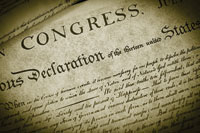
 Think about something as basic as the original Declaration of Independence. It’s entirely written in cursive. What will the phrase I need your John Hancock mean to generations to come? Will they even be able to read the signatures of John Hancock or for that matter, discern the signatures of artists like Frederic Remington and Charles Russell? How will they be able to read the rich journals of Lewis and Clark or the desperate writings of the Donner Party. How will they read and interpret the land grants that settled the West or Gold Rush documents that resulted in the development of San Francisco?
Riding the train recently from Chicago to Milwaukee, I had the opportunity to sit next to an elementary school teacher who was on her way to a special seminar at the Marquette School of Engineering. The week-long seminar was about teaching children in 2014 because it’s a whole new ball game now. I asked her about the long-term affects of eliminating cursive education from the schools. To be honest, she hadn’t really considered it. It may not have any affect in some areas but it will have a devastating affect on their education and understanding of history reaching back centuries if not thousands of years. We chatted a bit about this and her response was that it will all eventually be translated into printed text.
The information will remain but the ability to touch and feel and connect with those that came before us will be lost. Reading those journals of Lewis and Clark will be Greek to them.
Provenance and history is not only just the information and the facts, but the genuine archives and historic documents that remain that we thirst for and cherish.
Our mission in the pursuit to sustain and increase the rich and wild history of the American West just got tougher.
As a follow-up to last month’s “Consider Yourself Cutting Edge,”
Jayne Skeff continues to find good news.
Is Mainstream America
Finally Waking Up
To
The Richness Of The
American West?
What the media has to say…
By Jayne Skeff
 Well, the answer would seem, in short, to be yes. After just 200 short years in the making, it appears that the legacy of the West has finally come to the forefront in art and media in the most urbane of settings including New York and downward along the Eastern seaboard.
High Noon got its first hint of this trend a few years ago when luxury lifestyle magazine, The Robb Report, flew a writer out to Los Angeles to create a feature story around the richness of collecting Western saddles with additional follow-up stories on collecting Western Americana on their editorial calendar. The New York Times has featured numerous articles on this genre of collecting and most recently, the Wall Street Journal just completed a feature on the Wild West at Auction. And, a week doesn’t go by when there isn’t an inquiry from a TV production company looking for an angle to create a series on the wild world of Western America. It’s further interesting that most of these TV producers have been from London or New York and most recently, Paris. Well, it looks like someone in fact is watching and realizing what those of us in this world have always known.
When it comes to media attention, we all know money drives their interest, but there’s more to this than just that. In what could be considered a landmark move, for the first time since their doors opened in 1870, The Metropolitan Museum of Art in New York will be featuring an exhibit of Western bronzes. Scheduled to open December 18, 2013 and titled The American West in Bronze, 1850-1925, this exhibit will feature the works of Remington, Russell, Fraser and Manship to name a few, and their artistic representations of the Native American Indian, cowboys, cavalry and pioneers.
To get some validation on this trend and some explanations as to why, we decided to talk to the media themselves. In a time when major mainstream glossy magazines are on the downward spiral, page counts slashed in half or discontinued entirely, the Western lifestyle and art magazines are thriving, bigger than ever with subscriber bases reaching into Europe.
Western Art Collector began publishing in September of 2007. In an interview with Joshua Rose, Editor of Western Art Collector, he noted that, since their premier issue, the magazine has at least tripled in size and their subscriber base has greatly extended to the East Coast. Joshua took the time to share his insights on what’s driving this “stampede” to Western art and artifacts.
Western America “is like the new world of the New World. As cities get congested, the quest for freedom and space becomes stronger. People begin to retreat into the West even if it’s just through art in their home for solace. We are so consumed inside a world of technology and, as Contemporary art just keeps getting more contemporary, I believe people need and want something they can actually connect with and understand. Something that doesn’t leave you feeling empty when you look at it or touch it but fills you with the warm fuzzies.”
In regards to Western art specifically, Joshua said that, “There seems to be a much greater awareness of the scholarship about Western art. People and collectors are beginning to understand that the Tenny’s and the Remington’s and the Taos artists studied with the masters in Europe. Western art is now being seen as American Fine art and that’s a big transition.”
He also chatted a bit about money creating this new mainstream interest. “When you get big names in the news spending millions on a Billy the Kid tintype and the national and international media frenzy that the Roy Rogers auctions created, it all fuels a new awareness in people who would have never looked twice at the Western world of art and antiques and the new works being created by contemporary artists and artisans.” He also commented, “just look at the fashion magazines, they are full of Western inspired clothes and that says a lot.”
In closing, he feels that America is moving toward quality versus quantity and there is a great desire to buy what is truly American and created by artists and artisans. “Just look at all the craft and local beers, all the restaurants that serve local foods – people are thronging to these venues. Whether it’s Western art created masters of the past or present, art in food, art in your local brewery or wine, make people thirst for and are beginning to deeply appreciate what is truly American. And, luckily for all of us, Western American art and its lifestyle is just that.”
 Consider yourself
CUTTING EDGE!
Our beloved culture of Cowboys and Indians is being refreshed and regenerated by contemporary artists. Is it possible that classic, organic design travels through time and generations? That the younger generation is taking note of our collecting spirits and sense of history and design? When you consider this concept, you probably are thinking about Texas ranch folks, Oklahoma artisans and blue sky Colorado craftsmen. But think again, this time in New York.
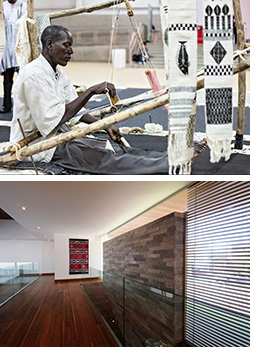
The 25th International Contemporary Furniture Fair in NY offered some surprises for us collectors. Julie Lasky of the New York Times wrote a front-page article, entitled "Going for the Remix" last week. The attached photo is a vibrant example of an artist taking a classic Indian pipe bag design, peeling back essential layers, and channeling its essence by weaving the image into a contemporary wall hanging. Massan Dembele, a master weaver from Burkina Faso (just North of the Ivory coast in Africa) sits at his loom made from logs and bound with twine, operating the loom with bare feet, and weaves fish and feathers from images stored in his head from generations past.
This generation may be super-charged by the antique reality shows, looking at antiques in a different light. They are experimenting by incorporating classic patterns and designs into new objects. They make bookshelves from canoes cut in half. They have uber-contemporary homes, yet have a Navajo rug hanging over an Eames chair, with a background of early California tiles on the fireplace. A rough and tough cowboy's face hangs on the wall, his image blown up and transformed into into pop art, Andy Warhol style and 20 pair of colorful cowboy boots line a white bookshelf. And lately it has been told that a gold and silver, 3 piece cowboy buckle is beginning to show up in court on the suit pants of a prominent city attorney.
If this is history repeating itself, then bring it on, next generation! Give us your best (creative) shot and we'll give you the best inspiration.
Linda Kohn Sherwood
Editor
From his current book Cowboy Real
Cowboy Horses
By Don Hedgpeth
The next day I caught up with him to ride, and he showed me a thing or two. He started to buck, and first my six-shooter went, then my Winchester went, then I went, and he finished up by bucking the saddle over his head. After that I would not have taken a million dollars for him.
TEDDY BLUE
Billy was the name of that little bay horse and Teddy Blue had him for twenty-six years. Cowboys say that is a fortunate man who gets to have one or two top horses during his lifetime. They also say that a man is known by the kind of horses he rides and how he rides them. Everything that has to do with cowboys also has to do with horses. Cows are just something that gives him a good reason to ride. The cowboy doesn't commune with the cows; it is the horse that has a hold on his heart.
>>READ MORE>>
 The Saga of Henry Starr
and Cherokee Bill
By Ron Soodalter
On a black July night in 1892, three men, all masked and carrying revolvers, entered the Missouri Pacific Railroad station in Nowata, Indian Territory. One of the bandits, a slim teenager with straight black hair and dark piercing eyes, walked swiftly up to the ticket window, and - for the first time in what would be a nearly three-decades-long career of crime - barked his signature command, "Thumbs up and stand steady!" Within minutes, they were mounted and firing their pistols in the air, $1700 richer, as they sped off into the darkness.
High Noon gets CAUGHT UP at the
Arizona Antique Show and Auction

A weekend of record rainfall in Phoenix did not deter Western enthusiasts, collectors, and those passionate about Western American history from attending the 23rd annual High Noon Western Americana Antique Show and bidding with fervor at the High Noon Western Americana Auction.
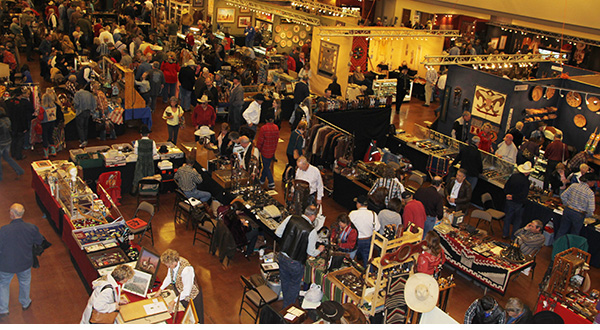
Held January 26 and 27, 2013 at the Mesa Convention Center and adjacent Marriott Hotel, the show saw record crowds fill the halls throughout the weekend and dealers reported very strong sales. The High Noon Auction also saw a record number of bidders reporting a new high in Internet registered bidders indicating a global reach and desire for the great American West. Overall, the High Noon Auction earned just over $1.8 million on the 308 lots offered with most lots going for within or over estimates. And, as always, there were a few surprises along the way...

 The Schroeder Saddletree Factory Museum
By Jamers H Nottage
Not all of the objects we associate with the American West are products of the region in whole or in part. Even Western stock saddles have been made elsewhere in the world in their entirety and with components from elsewhere. Today, there are a small number of specialists who manufacture saddletrees to serve the needs of saddle makers working in the age-old creation of rigs for cowboys. A few of the best of custom saddle makers in the West continue to create their own finely crafted saddletrees of the highest grade, designed to accommodate the demanding needs of both horse and rider. In the 1800s, saddle makers scattered throughout the American West followed the same pattern. Some created their own trees, the frameworks essential to shape and function of the saddle. Some purchased trees from specialist shops and many turned to major factories, including a significant number of them located in Madison, Indiana.
By 1880, there were a dozen saddletree factories operating in this southern Indiana community, producing tens of thousands of trees per year, employing 120 men and women and competing with other centers of tree manufacturing in Leavenworth, Kansas, St. Louis, Missouri, Newark, New Jersey, and New Braunfels, Texas. One source estimates that the combined production of these factories in 1879 was over 150,000 trees. One firm was founded by Ben Schroeder who was born in Prussia, immigrated to the U.S. in 1864 and opened his factory in Madison, Indiana, in 1878. The peak of his shop's production saw it shipping 6,000 to 12,000 saddletrees per year throughout the United States and to Canada and South America. According to interpretive materials available at the original site of the factory, the company produced 250 styles of saddletrees, and in the course of its history "made between 300,000 and 500,000 saddletrees, nearly two million clothespins, and countless stirrups, hames and work gloves." The shop closed permanently as a manufacturer in 1972 with the death of the last family member.
 Six Gun Myths and Bowlegged Reality
By Don Hedgpeth
This is part of a chapter from the book Traildust, which featured exceptional art of Jim Reynolds. The book was published by Greenwich Workshop Press in 1997
The story of the West is a tale of triumph and tragedy with a full cast of characters, both heroes and villains, in the best tradition of classical drama. One figure stands out more starkly than all the others, idealized and immortal in our collective consciousness: the cowboy. He is a symbol; of the idea of the West, both real and imagined, forever riding wild and free across a prairie dreamscape. Romantic fascination swirls around the cowboy and makes it difficult for us to see him clearly. Cowboy reality, both historical and contemporary, has been overwhelmed by a mythological haze of gunsmoke and traildust. The truth is hard to get at and is not what it once had been - when, in fact, it never really was.
The genesis of the America cowboy traces back through time and across a broad ocean to Spain. Conquistadors, haughty and brave, introduced cattle and horses to the New World when they landed on the shores of Mexico early in the sixteenth century. The Indians of Mexico became the first American cowboys. They adapted Spanish techniques of livestock management to new and diverse environments. Open-range cattle raising became an economic cornerstone of the Spanish colonial empire, spreading throughout Mexico and into American Southwest, particularly California and Texas.
The flavor and style of Spain were retained in the horse-back heritage of California. But in Texas, Hispanic vaqueros and Anglo cowboys developed their own way of doing things in response to the hard charter of the country. Texas cowboys, Texas horses and Texas cattle set the style for the Western livestock industry on the Great Plains east of the Rocky Mountains, from the Rio Grande north to the Canadian border.
The cowboy's golden age began in the dark days following the Civil War. As railroads built westward, shipping points were established in rough and rowdy Kansas cowtowns like Dodge City and Abilene. Millons of Texas cattle followed the old trader's track called Chisholm Trail northward across the Red River and on through the Indian Territory to the Kansas railheads...food for war-weary, beef-hungry nation.
 Hitched Horsehair
A Mystery
By Shoni & Ron Maulding
Hitched horsehair is a mystery. The pieces we see today are generally regarded as being made in western America territorial or state prisons, i.e. Deer Lodge (Montana), Walla Walla (Washington), Rawlins (Wyoming), Yuma (Arizona). And that assumption is somewhat correct. Except, what if the inmate was discharged or paroled, and hitched outside of prison walls? Or taught his family to hitch horsehair? Or what if the inmate reoffended and was incarcerated in other prisons? As for the maker, most times the paperwork trail dead ends before it even gets started due to lack of records. As restorationists, conservationists and hitchers, we are involved in both the old and contemporary world of hitching and each piece has its story.
Maybe it smells of cigarette smoke, or has holes where mice have chomped on it. Could be when it was tossed in an old shed, it hit a sharp ax. These observations are nothing compared to the questions of how or where it was made. Many examples were made in our prison system around the turn of the last century. What tools did the inmate have? Generally the only necessary things to hitch are the horse tail hair, string to hitch the knots over, and a stabilizer to create the shape such as a dowel or rope. Add in scissors, a blunt tip needle, and leather pieces. The knowledge of how to hitch could impede many -- who to learn from? How to get paid without using currency? (resulting in a large barter system within prison walls) How to obtain sharp tools when hobby permits, determined by security levels, could impede the inmates' ability to use them? Or perhaps a hobby was not permitted. How to use a torch for metalwork? Montana State Prison is a fine example of all these questions needing answers.
 We have talked a great deal about horses in Smoke Signals. It's time to recognize the
GREAT WHITE DOGS
of the San Juans
By Veryl Goodnight
These dogs are working, or as the one hiker noted, "They are on the clock." None of us would walk between a mother bear and her cubs, nor would we walk between a policeman and a police dog.
I am a dog lover. Period. I have owned many breeds and currently have a Jack Russell Terrier, a Rotweiller cross, and two Alaskan Huskies. Currently, I am attempting "minor" dog sledding with the huskies. The primal experience of sledding, while greatly limited by having only a two dog team, has peaked my interest in the many roles that dogs play in the lives of humans - for over 15,000 years.
Last summer, I encountered three herds of domestic sheep in the high Mountains of Colorado, between Lizard Head Pass and Silverton. The sheep themselves, moving like waves across the high country, were breathtaking. What really inspired me, however, was watching the great white dogs that accompanied the sheep herds.
 Kissed by a Giraffe
By Linda Kohn Sherwood
He was tall and lanky. Sweet, really, with those big, round, glistening eyes. And he came to my window to get what was his. I was in his home, visiting him and his wide family of distant cousins eating, frolicking, protecting, running and surviving throughout the plains of Tanzania and Kenya. He came to my window to get a kiss and a treat. Ok, maybe just a treat - the kiss was his price to pay.
The staff at the manor warned us that these were not pets. The giraffes were patient with us humans because they were rewarded for their behavior, but make no mistake. Walk up to a giraffe and startle it in any way and its kick could send you flying through the air or worse. Lions knew better. Do you read my words? I was on the same playing field as lions. But safer. Stay in the jeeps, they warned. These wild animals don't recognize you as a threat because you are not walking and are shaped like a jeep. Ok, I accept being shaped like a jeep just this one time. But the lions did get close, brushed the jeep as they walked by, perhaps to let me know this was their home.
 Viejos – In Praise of Older Horses
A little age on a horse shouldn't
be considered a disadvantage.
By William C. Reynolds
The sorrel gelding stood in the middle of the pasture. Looking through the fence rails, it was hard for her to get a good look at him. As she passed through the gate and walked towards him, it was evident he carried some years on him. When she arrived at his side, he stood soldier-still. She reached up and hugged his neck as he dropped his head so she could slip the halter on him. As she started back for the gate, he led right out with her at a good walk, staying at her side - not pulling ahead or dragging behind her. Minutes later, she had saddled him and crawled on. Together, they stood in the circle with the other riders, ready to move out for the morning's gather. Some of the other horses were much younger and were having some difficulty standing still - what with all the people and horses and the excitement they were starting to feel. Her gelding stood rock still, ears forward and ready for the day, while she re-coiled her rope and tied it on. This branding season would mark the gelding's 24th year and while he was older than most of the horses present, he wasn't old, just a little more seasoned. For the little girl riding him - she wouldn't want any other horse under her. Neither would her father sitting two horses away. That gelding had been through three of his kids - one boy had shown him in local 4H & FFA competitions, hauling him all over the West - while his other son had taken him through four years of high-school rodeo and an endless number of weekend team ropings - not to mention the countless gatherings and brandings on their ranch and on neighbors' places. Today, this little twenty-four-year-young gelding - a sorrel, grade horse with no papers or fancy registration to his name - carried a ten year-old girl - a third youngster in the family - into a new chapter of western adventures for both of them. "I wish I had a barn-full of horses like him," the father said. "That's a horse I could put anybody on and never worry." He smiled, looking over at her, "Now I can't get her off of him. He doesn't seem to mind though. Just hope he lasts."
 The Will James Society:
History and Heritage
Renewing its Purpose, Goals and Dedication
By Sharon DeCarlo
The Name Will James strikes a chord with most people. Artist? Author? Cowboy? No matter what the note, the name is familiar. 24 books from the pen of Will James has compelled little children to dream of becoming a cowboy (or cowgirl of course), sparked their imagination and peppered it with images he drew and tales he spun.
Curiously, Will was born Joseph Ernest Nephtali Dufault in Quebec, Canada in 1892. Still in his teens he left in 1910 and traveled to the United States with a new name, William Roderick James. He soon became everything he dreamed of becoming, the quintessential western cowboy! He drifted and worked for several western cattle ranches, worked as a stuntman in movies and served in the U.S. Army from 1918 to 1919. While in the Reno area he met and married his true love, Alice Conradt. With Alice's encouragement he sold his first writing, Bucking Horse Riders in 1922. Smokey the Cow Horse (1926) won the coveted Newberry Medal for Children's literature in 1927 and the Lewis Carroll Shelf Award, given by the University of Wisconsin, in 1965. Smokey was written at Will and Alice's ranch in Washoe Valley located about 30 miles south of Reno, Nevada, where his cabin still stands today. More wonderful, self-illustrated cowboy books followed, 24 in all.
 Me and the Music
By Don Hedgpeth
My Daddy came home from World War II with an arch top Gretsch guitar. He knew and could play and sing most all of the songs that were on the radio back then by the Hanks (Williams, Thompson and Snow), Ernest Tubb and he particularly liked Red Foley. Some of my earliest memories are of the West Texas beer joints and honkytonks where Daddy fronted a four-piece country band called the Ross City Wranglers. Saturday nights were family affairs in those places. Kids could run and play in the unpaved parking lot, and wander in and out of the dance halls to listen to the music.
I also remember the nights we would have company come to visit, or go to someone else's house. The men usually sat in the kitchen playing music and drinking beer. The women sat and talked in another room. All those houses seemed the same: just small shotgun shacks that were the common accommodation all over the West Texas oil fields.
 Ode to Mom (and/or Grandma)...
The History of Aprons
Anonymous, but sent to you all from
Linda Kohn Sherwood and her friend Dina
Remember making an apron in Home Ec? Remember Home Ec? If we have to explain "Home Ec" you may delete this. I just don't have the energy anymore. Read on.
I don't think our kids know what an apron is.
The principal use of Grandma's apron was to protect the dress underneath because she only had a few and because it was easier to wash aprons than dresses and aprons required less material. But along with that, it served as a potholder for removing hot pans from the oven. A "Medium" was size 14-16.
It was wonderful for drying children's tears, and on occasion was even used for cleaning out dirty ears.
From the chicken coop, the apron was used for carrying eggs, fussy chicks, and sometimes half-hatched eggs to be finished in the warming oven.
When company came, those aprons were ideal hiding places for shy kids.
And when the weather was cold, Grandma wrapped it around her arms.
Those big old aprons wiped many a perspiring brow, bent over the hot wood stove.
Chips and kindling wood were brought into the kitchen in that apron. From the garden, it carried all sorts of vegetables. After the peas had been shelled, it carried out the hulls.
In the autumn, the apron was used to bring in apples that had fallen from the trees.
When unexpected company drove up the road, it was surprising how much furniture that old apron could dust in a matter of seconds.
When dinner was ready, Grandma walked out onto the porch, waved her apron, and the men folk knew it was time to come in to dinner.
It will be a long time before someone invents something that will replace that 'old-time apron' that served so many purposes.
REMEMBER:
Grandma used to set her hot baked apple pies on the window sill to cool. Her granddaughters set theirs on the window sill to thaw.
The Government would go crazy now trying to figure out how many germs were on that apron. I don't think I ever caught anything from an apron - but love...
Photos:
Top - Linda Kohn Sherwood with her mother, June, 1951.
Bottom - Joseph with his mother, Syvia, August 1961
 Familiar Faces and Friends
By Don Hedgpeth
"Studyin' Bob" Scuddy once said. "Every day of my life I am forced to add another name to the list of people who piss me off." I don't get out and around people as much as Bob does. My list is a lot shorter than his, but I do have one, and those that are on it know who they are.
I don't make friends easily, not the kind that really count. It has always been difficult for me to be polite around people who talk a lot, but have nothing to say. And I am impatient with pettiness and pretension. Casual acquaintances generally consider me cantankerous, and I can live with that. I would much rather sit by myself on my porch and listen to the birds sing, than to engage in idle chitchat that passes for convivial conversation. Nothing gets my goat like the pinhead who phones only to ask, "What's going on?"
But in spite of all my social shortcomings, and to my surprise, I am fortunate to have some really good friends, and they have added immeasurably to my life. A friend, for me, is someone you can count on in the good times as well as the bad. Back in the wild times, the highest compliment one cowboy could give to another was to say: "He will due to ride the river with." Cowboys still honor the implication of those words from back when trail outfits had to cross flood-swollen rivers bounded by boggy banks on both sides.
Those I would ride the river with are scattered from Alberta down to Texas and over Arizona. Next to family, there is nothing I treasure as much as my friends. Some have gone on to glory, but just remembering them is still a comfort. I feel no need to advertise for replacements. I'll get by just fine with them that are left.
___________________________________________________________________________
Penned by Don Hedgpeth, our resident renaissance cowboy: historian, author, art expert, poet. He also sings and plays traditional cowboy songs and recites a few poems he has written. Don lives with his wife of nearly 50 years, Sug, and they, together, can be found at poetry and art gatherings, or at home in Medina, TX.
He does not have, nor shall ever have a computer. He has no cell phone nor typewriter and still writes longhand. He is wary of mechanical things getting between him and his muse.
Books by Don Hedgpeth:
Howard Terpning: Spirit of the Plains People
Desert Dreams, the Western Art of Don Crowley
The Texas Breed: A Cowboy Anthology
From Broncs to Bronzes: The Life and Work of Grant Speed
Under Western Skies: The Art of Bob Pummill
Bettina: Portraying Life in Art
Remember Me To Them That Ride By

Beads for the Sole
By James H Nottage
It is amazing sometimes how misinformation gains and maintains a life of its own, no matter how carefully we try to debunk errors about art, artifacts, history, and culture. I am convinced that one reason for this is simply that people can be surprisingly lazy, no matter how passionate they are, about really trying to become their own authorities when it comes to the things they collect. A case in point is wonderful beaded Northern Plains moccasins that also have the bottom surfaces fully beaded in colorful designs compatible with the tops.
It was more than a few decades ago when during my childhood I was told that these were "burial moccasins." Over the years since, I have heard curators, collectors, and dealers use this reference and it often appears in collector publications and even in museum catalogs. One historian tells us that these were first observed in the 1870s on the bodies of Sioux found in burials after battles. As a result the myth began to grow. There is truth that such fully beaded moccasins were found in burials and that it was common to dress the deceased in the finest way possible. For a long time now, we have known that these were not identified by the cultures themselves as having been made for burial purposes. The cost of materials, the effort to create, and the status that came from such fine belongings was a matter more of stature and material wealth. Within a burial they were also a sign of respect.
PHOTO ABOVE: Late 19th century Lakota moccasin with fully beaded sole.
 The Beautiful Baskets of Northwest California
By Mary Lou Walbergh
The livin' was easy, and the art was superb. From the late 1800s, the tribes of the far Northwestern California created baskets unmatched for beauty anywhere in the world. It has been speculated that this was possible partly because the climate was fairly benign, the rivers were teeming with salmon, the woods full of deer, and the oaks loaded with acorns. This allowed for a culture in which talented women were able to weave long hours every day, honing their skills to a level which is not possible in these complicated modern times, and creating baskets of rare beauty.
These baskets are known, collectively and informally, as Hupa, because the local trading post was located in the town of Hoopa (incorrectly spelled by the whites who named it) but actually there were six tribes living and weaving baskets within that tiny space: Hupa, Yurok, Karuk, Tolowa, Whilkut and Wiyot. They all spoke different languages, and indeed, those languages derived from three different base languages: Hokan, Athabascan, and Algonquin.
PHOTO ABOVE: A small trinket basket by Elizabeth Conrad Hickox. The swooping knob, intricate design, and use of quill and fern are hallmarks of her distinctive style.
Wolves in the Art World
By Don Hedgpeth
Excerpt from: Remember Me To Them That Ride By
There was a time in the West, twenty-five or thirty years ago, when the western art business more closely resembled the buying and selling of used cars, or furnishing new clothes for the emperor. Caveat emptor was the watchword, and novice collectors were most often at the mercy of shady charlatans for whom culture was only a commodity. They roamed backroads across the West in old vans and decrepit station wagons with paintings stacked in the back and bronzes wrapped up in thin blankets stolen from cheap motels. It had always been impolite out West to ask where a man came from, and the same seemed true when it related to paintings and their provenance.
I remember, back in the early 1970s, when one of the original western art wolves from Kalispell, Montana, showed up in Cody, Wyoming, with a large W R Leigh painting covered in plastic garbage bags and strapped on the top of his car, and another time when a particularly mysterious and evasive entrepreneur disappeared after supper, leaving his station wagon packed with paintings parked on the street in front of our house for two weeks in the middle of a Wyoming winter.
A little later, back in Texas as the oil boom began, I watched the art wolves from Scottsdale and Dallas descend on Midland, drawn to the sweet scent of new money. They lined up paintings along the walls of dimly lit motel rooms where whiskey flowed free and hundred dollar bills were the currency of convenience. My son Cody who was about eight at the time, sagely observed that the western art business was like a game played without any rules.
A lot of mediocre and really bad art changed hands in those days. From time to time, I am amused when I see one of those old pieces show up again in an auction somewhere, like an old horse with a bunch of brands.
Sometimes, I miss those old days, and especially some of the more colorful scalawags, like the one who once told me he had always been as honest about the art as the company and circumstances would allow. Those days are done now, and I guess it's probably for the best. But they made good memories.
__________________________________________________________________________
Penned by Don Hedgpeth, our resident renaissance cowboy: historian, author, art expert, poet. He also sings and plays traditional cowboy songs and recites a few poems he has written. Don lives with his wife of nearly 50 years, Sug, and they, together, can be found at poetry and art gatherings, or at home in Medina, TX.
He does not have, nor shall ever have a computer. He has no cell phone nor typewriter and still writes longhand. He is wary of mechanical things getting between him and his muse.
You will see him at the 2012 High Noon Antique Show in January - he will be in the Main Hall hanging out with his buddy John Moyers.
This piece is part of an essay he wrote for a Clagget/Rey Gallery catalog a couple of years ago.
Books by Don Hedgpeth:
Howard Terpning: Spirit of the Plains People
Desert Dreams, the Western Art of Don Crowley
The Texas Breed: A Cowboy Anthology
From Broncs to Bronzes: The Life and Work of Grant Speed
Under Western Skies: The Art of Bob Pummill
Bettina: Portraying Life in Art
Remember Me To Them That Ride By
 One of My Favorite Things, Maynard Dixon’s Painting, Hill Camp
By James H Nottage
As a museum curator, I have seen many remarkable artifacts and works of art over the years. One thing that strikes me is that sometimes small works can have a huge impact that goes well beyond their size or medium. Providing a little detail about one of my favorites, gives me the opportunity to marvel at an early work by California painter, Maynard Dixon.
If you have not visited the Eiteljorg Museum of American Indians and Western Art where I work in Indianapolis, you cannot fully appreciate the extraordinary collection gathered by our founder, Harrison Eiteljorg. Among the museum's treasures is Maynard Dixon's 1938 oil painting, The Cow Country, painted in the year he moved to Arizona. It is a formal and mature, 30" by 40" painting, rich in design, color and composition. This is the kind of painting that any major collection would be proud to have. Also collected by Eiteljorg, however, is a small watercolor, just 8 7/8 inches high by 11 3/4 inches wide. Below the artist's signature is simply written, Hill Camp, Ore. June 1, 1901. Despite its size, this small painting cannot be dismissed as a minor work. I will tell you why.
>>READ MORE>>

The Genesis of Western Clippings Newsletter
By Boyd Magers
Dedicated to preserving the rich heritage and enduring memories of small and big screen westerns and the people who populated them, WESTERN Clippings was born in September 1994...
I've always felt I grew up at just the right time for a full appreciation of all westerns...the late '40s-early '60s.
 My youth was spent in Independence, Kansas, near where the Dalton and James Gangs rode, and Ponca City, Oklahoma, the site of the famed 101 Ranch. In the '40s I was riding the Saturday matinee range with Roy Rogers, Gene Autry, Charles Starrett and others. By '53 the new medium of television offered me a steady hour upon hour appreciation of the early screen cowboys - Buck Jones, Ken Maynard and the rest. The early '50s was also the time for the dawning of dozens of TV westerns, so I came to appreciate all eras of westerns.
From '87-'94 I contributed a regular column on westerns to The Big Reel as well as writing various other articles. In '94 my wife Donna and I began self-publishing WESTERN Clippings with the purpose of keeping the honesty and moral values alive in the hearts and minds of other western film devotees. Our unique western movie and TV history must be remembered and preserved just as has the real West.
We're honored to have rounded up several name columnists as contributors over the years, including Will Sugarfoot Hutchins who has been with us since the first issue; stuntman Neil Summers; singer/actor Johnny Western; late actor Michael Pate; Ty Bronco Hardin for a brief period and Roy Dusty Rogers Jr., along with other noted historians.
Offering a diverse look at westerns from the silent era to today has made WESTERN Clippings the respected and successful publication we had hoped for. It gives us the same kind of pleasure all those westerns have given me all these years.
______________________________________________________
You are welcome to contact Boyd and Donna at:
Boyd Magers, WESTERN Clippings
1312 Stagecoach Rd SE
Albuquerque, NM 87123
(505) 292-0049
www.westernclippings.com
Both Boyd and Donna Magers are two of our Smoke Signals readers who kindly shared their story with us. We encourage you to share yours!
 Dan Katz, an ardent collector from Connecticut, beautifully articulates his (and our) passion for collecting
By Dan Katz, Collector
Not everyone is a collector of anything. Though sometimes difficult for me to understand, the affliction which we label collecting, in fact, affects very few of us and a fair question arises as to what motivates the few who do enter the fray of the collector scene.
Two motivations for collecting stand out, I think. One is an interest in a general, broad area (art, antiques, western memorabilia) for the purpose of buying low and selling dear as a chosen way of making a living. The second, is an interest in a narrower area of the same category types but with no (or little) interest in resale. This is the more puzzling kind of collecting, the more peculiar kind of collector and, sadly for my family, the category into which I fall. For me, the chase is for lawman guns and badges, cowgirl guns from wild west shows, cowgirl trophy buckles and photographs.
Sure seems a useless way to spend time; a bunch of guns I don't shoot and won't sell, a pile of outdated badges, dozens of frilly buckles I can wear only in Palm Beach or Provincetown, MA, where they have no rodeos, and hundreds of photos I have little room to display. What the hell am I doing?
I am surrounding myself and my family with our uniquely American Heritage.
The guns and badges say that our constitutional respect for law was constant even during the lawless days of westward expansion; the cowgirl trophy buckles and wild west guns say that women were an integral (though under-appreciated) part of the country's growth and the western mystique with which we are so enamored; and the cowgirl photos remind me that, even in the tumultuous, unimaginably tough times of westward expansion, beauty and calm were present.
Collecting like that described above is more than acquisition. Even if pieces are sold off in order to make room for other items, such collecting becomes part of the person doing the collecting and, happily, becomes part of the self you take with you wherever you go.
_________________
Dan Katz is one of our Smoke Signals readers who kindly shared his story with us. We encourage you to share yours!
You can email Dan at: trurodan@aol.com
 Cowboy Aesthetic
By Don Reeves
Skilled craftsmen are familiar with that feeling, the need to create, but few verbalize their desire. The urging. A vision not so much seen as felt through the hands. There is an expectation of shape and line as fingers explore the supple texture of fine leather. The clay-soft yielding of fine silver as the graver cuts a graceful curve and then exits with an upward flourish of the master's hand.
At what point does a functional object transcend its function, yield to aesthetic desire, and become an objet d'art? Does a saddle, bit, quirt or silver concha begin as a tool destined to serve a particular task and then take a turn, throw off the shackles of utility and head toward the trophy room or mantle? Such objects are conceived, designed and executed by master craftsmen - artisans - in the process of creating works that attempt to reach an envisioned aesthetic.
 Stuff I Know About Indian Camp Blankets
By Barry Friedman
While still doggedly pursuing my theory that Brian Lebel is Arnold Schwarzenegger's oldest love child, I've decided to take a momentary step back from that twisted tale to further educate Smoke Signals readers on my specialty, American Indian trade and camp blankets.
Certainly nobody can forget my March article that dealt with the history of the American Indian trade blanket. Everybody's still buzzing about that one and now here I am about to explain Indian camp blankets! I can hardly imagine your excitement and would give anything to be in your shoes and/or Lucchese's.
You'll recall that the fine wool geometric pattern blankets produced by Pendleton Woolen Mills and their competitors instantly became a staple of North American Indian life and remain so today. Pendleton is the only surviving pioneer trade blanket manufacturer and was the only mill that specifically went into business to create blankets for the Indian market. They manufactured their first blanket in 1896 and from the beginning made a very high quality product that commanded a good price.
>>READ MORE>>
 Laramie Tales
By James H Nottage
We do not pay close enough attention to them, but every community has residents who carry memories of local history that can sometimes carry us back to pivotal points of change and growth. The problem is that all too often these memories go unappreciated and unrecorded. Certainly, political and economic leaders get a lot of attention. I am making reference to those everyday people who were solid, contributing, but modest and nearly invisible residents - the ones who time tends to forget or at least not to acknowledge. How many times have you said or heard someone else say that an elderly relative or friend should sit down with a tape recorder or write their story to preserve they know about the past? How many times do you end up, at the person's passing, with regrets that this was not done?
One of my favorite members of one of the founding families of Laramie, Wyoming, was Miss Martha Wallis. In the days before the public raised funds to preserve the Victorian mansion of the Ivinson family as an area museum, the Albany County Historical Society held regular meetings at a community center - a surviving building of Fort Sanders that had been built in the late 1860s. It was at one of these meetings in the mid-1960s that I first met Miss Wallis. What fascinated me was learning about her home, the small stone house at 419 South 8th Street, that her father Noah Wallis had built in the 1880s. The junior high school I attended was across the street and next to the house was the original barn where the Wallis family kept a carriage and horses. One afternoon, after school, Miss Wallis agreed to let me stop by and ask her about Laramie history.
>>READ MORE>>
 Billy the Kid is Coming to Denver
The one-and-only authenticated photograph of Billy the Kid - the famous Upham tintype - will be offered to the public for the first time ever at Brian Lebel's Old West Auction this June.
Denver, CO - 130 years ago, legendary outlaw Billy the Kid had his "picture made" in Fort Sumner, New Mexico, posing for what is now considered the most recognizable photo of the American West. A single, original tintype is the only authenticated photo of the Kid in existence today. Descended through one family, and never before offered for public sale, it will be sold at auction on June 25, 2011 at Brian Lebel's 22nd Annual Old West Show & Auction, to be held at the Denver Merchandise Mart in Denver, CO. A famous, historical item with impeccable provenance, the tintype is estimated to bring between $300,000 and $400,000.
 Witness to Her Times,
A Wyoming Pioneer Teacher
By James H Nottage
Photo:
Esther Hobart Morris, Wyoming symbol of women's rights.
In a column some time ago, I wrote about Bill Carlisle, the Wyoming bandit who robbed Union Pacific trains early in the 20th century. At the end of the article I commented that I have a few other favorite personalities who inspired my interest in history and that if the good folks at High Noon agreed, I would tell you about some of them. With words of encouragement and an occasional nudge about pressing and missed deadlines, my friend Linda has encouraged and allowed me to do so.
Let me say that in junior high school I had a great and inspiring social studies teacher named Eugene Brown. He was one of the sponsors who helped in the formation of a junior historical society. This small group of history nerds dutifully and enthusiastically gathered, elected officers, and decided upon what we would do. We determined to check a tape recorder out of the audio-visual department and conduct oral history interviews with area old-timers. Bob Burns, co-author of an important book on Wyoming ranching was an early victim. Soon thereafter, with the advice of my father, we introduced ourselves to Mable Wyoming Cheney Moudy, the oldest living graduate of the University of Wyoming. She was 86 years old and kind enough to allow us to spend a number of afternoons talking with her about Wyoming history.
 Indian
Trade
Blankets 101
Indian
Trade
Blankets 101
By Barry Friedman
As I reminisce about all the comments I've heard over the years at the High Noon show, one observation clearly stands out. When asked what he thought about the caliber of dealers on hand, a very astute gentleman let his gaze sweep across the room and said, "This is the smartest group of unemployable people in the world."
He got that right. We're all authorities who question authority. Working for someone else? Unthinkable! Nobody would hire us and we'd quit if they did. Most of us are so ornery we can barely stomach working for ourselves. We're all clearly out of control with zero chance of recuperating because we all share Wild West disease. This silent killer usually strikes when the victim is young and the next thing you know you're middle-aged and passionately talking about woolies, unraveled bayeta, pommel bags and slobber bars to anyone who will listen.
 A Memory of Midnight
In praise of great dude ranch horses
By William C Reynolds
At left:
Billy Reynolds, Christmas 1957.
A new western shirt and bolo tie
for the annual spring visit to the
Alisal Guest Ranch in Solvang, CA.
As a kid of the early 1950s, wrapped up in all things cowboy, the idea of getting to go to a dude ranch for Spring Break was my idea of heaven. Back then they were called Dude Ranches, and for some very good and obvious reasons - mostly with regard to their guest's riding skills. Those reasons still exist today - but we now call these places Guest Ranches in deference to those dudes among us with questionable self-image issues. The one thing that hasn't changed, thankfully, is the quality of the horses. In fact, in many cases, the horses on guest ranches today are even better. Unless you were as horse crazy as I was, it's difficult to describe to someone afoot the true wonder and joy of a kid's first ride on one of those great dude string horses.
It's a guiding rule of guest ranches: great horses = great ranch experiences. Of course, the food has to be good, the view a knock out and the beds have to lull you into the sleep of angels, yet there is no greater asset that can ensure a wondrous ranch experience than being assigned your own personal Trigger during your stay. Those assignments remain among some of my greatest memories.
 The White Masked Bandit
By James H Nottage
I remember him clearly, an older gray haired man, slender with the kind of wind-worn face common to men who labored to make a living in the Wyoming of cowboys and railroaders. These were the men who scraped out a living in this often unforgiving land. Some of my earliest memories as a child come from listening to this man chat with my father while I sipped a grape soda. He operated tourist cabins on the east edge of Laramie and my father delivered Sinclair gasoline to his adjacent gas station.
As an avid fan of Hopalong Cassidy and Roy Rogers, I was all about Wild West shoot outs, galloping horses, and the scenarios of the fictional 1950s Westerns. Imagine the fascination of learning that the scars on the man's left hand were from a bullet wound earned in a shooting following a train robbery gone bad! That certain difference between the mythical West of television and movies and the real West of Wyoming was clear and evident to my young imagination.

The (He)art of a Collector –
Born or Bred?
By Linda Kohn Sherwood
Smoke Signals Editor
I sat down to lunch with one of our cherished collectors, Carl Robertson. He and his wife Sue Robertson have a beautiful Los Angeles home filled with creative objects, reflecting their integrated, exceptional taste. They have world-class collections of 17-18th century American furniture, Western Americana, art, textiles, among others, all set in a physical space that amplifies the beauty of each piece.
I wanted to learn what makes Carl's collecting gene work so well. And the answer is - he has it in his blood. Growing up north of Chicago, eventually moving out to a farm community in the 1940s, Carl purchased his first piece at the age of 15 at an old farm in Wisconsin. No, not trading cards. Not toy horses. But a drop-leaf dining room table! He bought it he said, because it had the original finish. Did he have a place of his own at that age to use or store it? No, of course not. But he had to have it. Did he purchase it to make money? No, he answers, great collectors love the objects first, and the possibility of making money with them is low on the list.
 Packing Your Kit,
The Transformation of Cowboy Leather Goods
By James H. Nottage
In this day of mass-produced goods and media manipulated marketing, it is no surprise that there is a clear sameness in the design and appearance of every kind of product from clothes to cars to electronic gadgets. Everything looks alike and when something new does have a distinctive appearance, you can bet that others will soon be copying it.
For those of us who enjoy the history of Western, and especially cowboy leather goods, there is something about the unique styles of saddles, gun belts, boots, and other gear that is very appealing. You can document particular fashions of shape, function, and design that are characteristic of regions, especially during the last half of the 19th century. As time passed, however, we clearly see how homogenized certain styles became. As an example, the classic cowboy saddle of the 1880s that we think of as the "Cheyenne" saddle, with square skirts, rolled cantle, and other attributes is easily spotted in catalogs, old photographs, and actual specimens. As most collectors know, however, saddles of this exact type can be marked by makers from Montana to California and even beyond. How did designs and forms spread so quickly?
Photo: Main & Winchester Saddle, Sold 2009 Brian Lebel Old West Auction

Sacred Sixguns?
Navy Colt revolers and Christian symbols decorate this church – a unique monument to one of the world’s greatest arms designers
By Phil Spangenberger
Have you ever heard of a church using firearms art to embellish its architecture? There is such a holy structure in Hartford, Connecticut-the home of revolutionary arms inventor and manufacturer Samuel Colt. When Samuel Colt passed away in 1862, his widow, Elizabeth Colt wanted to build a lasting memorial to him. After a few years, when it was realized that the congregation of the Episcopalian parish mission in the South Meadows area of Hartford, was outgrowing its original facility, Mrs. Colt decided that the construction of a new house of God would be a fitting memorial to her late husband, while providing a place of worship for the workmen at the nearby Colt's Armory.
 A Race to End All Races
The true exploits of horseman Francis Aubry
By Ron Soodalter
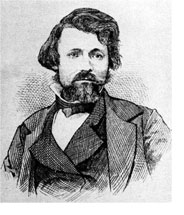
The nineteenth century American West was the time of the horse, in both fact and romance. It was also the time of the Great Western "windy" - the tall tale, or the outright lie, depending on the sensibilities of the listener. By now, every true fan of Western History knows that this year marks the 150th anniversary of the Pony Express, which gives us a splendid opportunity to consider afresh the countless claims - mostly spurious - of would-be Express and long-distance riders. No sooner had the Pony Express passed into legend than dozens of men from all over the country - including such luminaries as Buffalo Bill Cody and Wild Bill Hickok - claimed to have been connected in one way or another with the little corps of mail riders.
Nor were the many claims of fantastic deeds a-horseback limited to the Pony Express. If the film "Hidalgo" is any indication, there was never a rider to match the verve and stamina of Frank T. Hopkins when it came to endurance riding. Sadly, Hopkins' claims to have successfully ridden over 500 races, to have belonged to Cody's Congress of Rough Riders, to have been half-Sioux, to have coursed the Arabian desert, to have, in fact, played even the slightest role in the settlement of the West, appear to be just so much...well, horse-pucky. It's almost enough to destroy our faith in heroes. Almost.
 Chinacos
By Danny Neill
We can define Chinacos through various times of history. They were guerrilla liberals in Mexico during the War of Independence. They were common people. They were horsemen, independent, proud, and artisitic. But they were not always so.
These men originally came from Spain, from the Salamanca and Andalusia areas. They learned of horses from the Moors who conquered Spain in 711 AD and stayed for over seven hundred years. The Moors brought them Arabian horses, which were lighter and faster than the European horse. They also introduced them to a smaller saddle with bags, spade and halfbreed bits, spurs, and fancy outfits. And the Spanish adopted all of these new ways to fit their needs.
By the time Cortez came to Mexico in 1519 he brought over three hundred men who could ride horses and fight, many of them Chinacos. As more men came from Spain and the fighting slowed down, the Chinacos settled in haciendas, eventually owning cattle ranches, becoming proud riders, representing personal independence and respect in the cultural context.
 The Smartest Horse in the World
From your editor: Linda Kohn Sherwood
Most of us have heard about the museum closing. Many of us have been to one or another of the auctions set to disperse the collection. Now that the final auction is coming up this week, it makes me think. What was the organic appeal and reaction to Roy and Dale from within us all? We've talked in our press releases about what good people Roy and Dale were. Their legacy certainly reflects their moral values and how they influenced all of us children of the 40s-50s (more or less). And, of course, Roy loved his children, but he also loved his horse!
I was at dinner last night with my sister-in-law, talking about our relationships with our animals: our horses, our dogs, our cats. Roy's most loyal companion was Trigger! Here was a horse who listened to his every word! Who among us can say we have someone like that! Trigger carried Roy everywhere, danced with him, bowed with him and ran with him. And Roy fell in love the minute he rode him for the first time. Trigger was then called Golden Cloud (after the manager of the California ranch where he was born, a man by the name of Roy F Cloud). He had an easy lope and a calm and willing attitude. I think it was Smiley Burnette, Roy's sidekick in the film Under Western Star", when Smiley commented, "Roy, as quick as that horse of yours is, you ought to call him Trigger." Roy liked the suggestion and began calling Golden Cloud by his new name of Trigger from then on.
 Joe: A Blue Collar Thoroughbred
by Bob Cloud
I've known two track stars in my day. One was a high school distance runner who set and held, for many years, the Texas state high school record for the mile. The other athlete was a five-year-old, twelve hundred pound bay gelding named Joe who positively loved to run.
I met Joe the summer of my thirteenth year while I was pretending to learn how to work cattle on my uncle's place near Matador in the Texas panhandle. Joe was a ranch hand himself who had fallen into bad favor with the cowboys that had to work him because of a flaw he had developed. That flaw was his propensity to chase jackrabbits. When one would spook out from under him, he didn't jump away from it like normal, instead he would make one jump then wheel and be after it in a flash leaving the poor sod that happened to be aboard at the time in an immediate state of free fall onto what ever the Texas landscape had to offer. Most of which is hard and sharp.
 The Lovely Women of Mexico: Charra, China Poblana
By Danny Neill
The women of Mexico were the first cowgirls in the new world. As young girls growing up on ranches in the fifteen and sixteen hundreds, they learned to ride horses but would only ride sidesaddle as it was not ladylike to ride astride.
Clothing worn by the native women in rural Mexico was known as China Poblana. The legend was often told to young women about a pirate who captured a junk, a Chinese boat, on which a Chinese princess was sailing to South America. Along the way, she was sold to a Mexican Merchant who freed her on arriving to Mexico and had her baptized Catarina de San Juan. She was so charitable and generous that she became known as La China and thereafter, that's what her colorful outfits were called.
 Taste and Collecting the West
By James H. Nottage
For some reason, I have been in a philosophical mood lately, reading some favorite old books and considering the broad world of Western American art and artifacts. Please indulge me for a short while.
 In certain circles, if you talk about culture and collecting, they think you mean French provincial furniture, English paintings, and maybe Meissen China. There is a definite snobbishness about art and antiques that has been prevalent for generations and it often centers around what someone else says has value and significance. Historically, the "important" arts have been from the lives of those in Europe or part of elite Eastern American society. In 1949, Russell Lynes authored an influential volume entitled The Tastemakers in which he talked about how collectors and the general public are influenced by a wide range of voices coming from museums, scholars, artists, decorators, designers, authors and many others. Each adds to the knowledge, insights, and even ambitions of the collector. Lynes concluded his book writing that "unless I completely misunderstand the real reason for having taste, it is to increase one's faculties for enjoyment. Taste in itself is nothing. It is only what taste leads to that makes any difference in our lives."
Western Leather Goods, Union Made
By James H. Nottage
Near Midnight Pass
When we think of classic Western cowboy saddles, chaps, gun belts and holsters, cuffs, bridles, and other goods it is easy to picture independent business manufacturers scattered throughout the frontier. While small shops were common, there were also major factories and going concerns that might have large numbers of skilled leather workers. As early as the 1850s, union organizers became active. By the 1890s, the United Brotherhood of Leather Workers On Horse Goods could boast members in a large portion of the big shops. Among the rarest stamps to be found on some of cowboy goods, is that of this labor union.
 Black Powder Framed Peacemaker–
What Does it Mean?
Among many Peacemaker fans, there's a misunderstanding of the terms "black powder" frame or "smokeless" frame, so let's clear the smoke.
By Phil Spangenberger
Among today's shooters and Colt Single Action Army (SAA) revolver collectors, we often hear the terms "black powder frame" and "smokeless frame." These are relatively modern terms (dating from roughly around the mid-20th century when gun collecting was gaining in popularity) and are used primarily to describe the era that a Colt Peacemaker represents. The "black powder" moniker comes from the fact that, the first Peacemaker Colts were made with a cylinder base pin retaining system that used a single screw, located at the front of the revolver's frame. In 1896, at around serial number 165,000, Colt changed over to the so-called "smokeless" frame, where the cylinder base pin is held in place by spring-loaded cross-pin screws. Ironically, this system has nothing to do with smokeless powder, since Colt did not guarantee any of their 1873 Single Action Army revolvers for use with the then new smokeless propellant until around serial number 180,000 (1898). Furthermore, this system had been employed as early as 1877 and again in 1878, on Colt's double-action models. It's simply a modern collectors' term to differentiate between the two types and/or eras of manufacture of the 1873 Colt SAAs.
 Charles F. Lummis:
A Westerner with a Mission
By William C. Reynolds
Like so many things in Los Angeles, the landmark Southwest Museum was helped getting started by a character - a college dropout. Charles Fletcher Lummis (1859-1928) had all the makings of a classic pioneer entrepreneur. He was a journalist, publisher, photographer, amateur anthropologist and passionate historian of the American Southwest. If he were in L.A. today he would have a screenplay rolled up in his back pocket he would want you to read as well. Lummis was a writer for a fledgling newspaper out west called The Los Angeles Times. In 1894 he became editor of a new magazine he started that promoted visiting the West, Land Of Sunshine. Among his other self appointed taskings was to push for the preservation of the California Missions as well as helping create L.A.'s first free public museum of the regions art, history and culture.
All these accomplishments were part of Lummis' personal mission to celebrate and help protect what he perceived as a rapidly disappearing appreciation for the pastoral "days of the Dons" of the old Californios of the early 1800s. So when Lummis came to Los Angeles he found that while there was a mildly nostalgic remembrance of the "old days" - the remnants of that truly elite Californio culture were either leaving or deeply in debt due to the rapid influx of new immigrants coming up from contemporary Mexico, individuals with little or no memory of the area's elegant agrarian past. This was unacceptable to Lummis, and as an educated easterner he brought with him a natural understanding of how to not only celebrate this unique pastoral history of the area but also promote its uniqueness and romantic attraction. His participation in creating the Southwest Society in Los Angeles presented a unique opportunity to record and protect the spoken history through the regions Spanish songs - in a way only Lummis could describe, "Before they disappeared like snow in the California sun." Using the most contemporary of tools, an Edison wax-cylinder recorder, by 1905 he had recorded over 100 songs in twenty-four native languages and over 400 Spanish compositions. A task he continued until 1912. In 1923, he published fourteen in his classic sheet music collection, Spanish Songs of Old California with the help of composer Arthur Farwell. The collection includes serenades associated with life on the rancho along with nursery songs that had been taught in many of the area's early mission schools.
As a staunch advocate of regional cultural promotion, Lummis' work as pioneering folklorist helped create a roadmap for later folklore ethnologists to follow. Uniquely, he was quite clear as to what he was accomplishing at the time as he felt the continuance of the viejo Californio culture's roots were critical to the "civilized" evolution of the area. An area he saw as a place where others would travel to for both "rest and revitalization." He was a unique and passionate westerner, a force to be reckoned with. A friend of his, Gene Rhodes, wrote a final tribute to Lummis after his death, "He was a remarkable man - his scholarly thoroughness, his appalling industry, his rapier-like wit, and the militant heart that never feared to make a foe in a good cause. He finished what he started and he paid for what he broke."
Learn more:
Much of this article's information, and much more, regarding this topic - the romantic appreciation of the Californio and its implications in the twentieth century, can be seen in McWilliams', North from Mexico, and Leonard Pitt's, The Decline of the Californios: A Social History of the Spanish-Speaking Californians, 1846 - 1890 (Berkeley and Los Angeles: University of California Press, 1966)
 Up in Smoke...
When Your Collection
Bites the Dust
By Bob Sandroni with help from
his treasured co-pilot and wife, Lora
On October 22, 2007, my wife and I suffered the loss of our 7,500 square-foot home in Lake Arrowhead, California. In a few hours, our mountain sanctuary for 18 years, our family destination for holidays, birthdays and other milestones, and our showcase for our Western and Native American art disintegrated.
Gone were more than 1500 antique weapons, hundreds of salesman saddle samples, historic chaps and gun belts, museum quality Native American beadwork and oil paintings.
What can one learn from such a tragedy? A lot. What prevented this disheartening disaster from becoming an emotional and financial debacle?
 Special Announcement from Roy Rogers Jr.
I have been personally agonizing over how to start this letter. I guess I will start by saying thank you. Thank you for the years of love, support, prayers and loyalty to the Rogers Family. You, the fans, and our Board of Directors, are the ones who have kept our family's museum going for over 42 years. It has been a wonderful ride. After millions of visitors and countless stories of what Roy and Dale have meant to you, the Board of Directors have voted to close our doors of the Museum at the end of 2009. This has not been an easy decision. Many very emotional and financial issues have been addressed by all of us, as you can well imagine.
The decision to close the Museum has come after two years of steady decline in visitors to the Museum. A lot of factors have made our decision for us. The economy for one, people are just not traveling as much. Dad's fans are getting older, and concerned about their retirement funds. Everyone is concerned about their future in this present economy. Secondly, with our high fiscal obligations we cannot continue to accumulate debt to keep the doors open. This situation is one I have not wanted to happen. Dad always said- “If the museum starts costing you money, then liquidate everything and move on.” Myself and my family have tried to hold together the Museum and collection for over 15 years, so it is very difficult to think that it will all be gone soon.
What will happen to Roy Rogers, Jr and his family? For those of you that have heard I am retiring, nothing could be farther from the truth. My company, Golden Stallion, and its show tribute to Roy and Dale, will continue. I plan on taking the show to another venue in Branson. We are looking for space now. The show will also be available to travel around the country and take the message of Roy and Dale wherever we travel. I feel that this country needs the message that Roy and Dale always put forth, not only in their professional lives, but in their private lives as well.
The Museum's last day of operation will be December 12th. We want everyone to have the opportunity to visit the Museum one last time to see the collection in its entirety. This will be your last chance to see Roy and Dale's collection. Tell your friends and encourage them to come, before we close. This will be your final chance!!
Please keep us in your thoughts and prayers. Remember, Roy Rogers and Dale Evans will live forever in our hearts and minds, and will continue to ride across the silver screen through their movies. Every time you think of Roy and Dale, that warm feeling you have always felt, will always return.
Watch our website for further announcements and special dates.
I leave you all with Dad's favorite saying- Good bye, Good luck, and may the good Lord take a likin' to ya! See you in Branson, or on the road.
Love to all of you!
Happy Trails.
Dusty and Family
High Noon is honored to help the Roy Rogers/Dale Evans Museum spread the beauty, memories and artifacts inside its walls out into the hearts and homes of people all over the world.
December 3, 2009 – Christies in New York will be offering musical pieces from Roy and Dale in their Country Music Sale in New York
www.christies.com/eCatalogues/index.aspx?id=422E6D74FC4B0F3F8525756D0058A2C3
On January 30, 2010 we will offer a few of the very special pieces owned by Roy and Dale in our annual auction to be held in Mesa, Arizona. Included will be one of Roy’s fabulous Bohlin silver saddles as well as his personal Bohlin Spurs, Gun Rig and Colts plus his Rose Parade Grand Marshal saddle, as well as buckles and personal clothing
On July 14-15, 2010 High Noon will be offering approximately 600-800 other high quality, very personal items from the Roy and Dale Museum. High Noon is teaming up with Christie’s Auction House and will hold the auction in New York City.
Please watch both the museum and High Noon websites for more details.
 By James W. Nottage
October, 2009 Smoke Signals
Leonard Pitts, a columnist for The Miami Herald, wrote a column recently lamenting that in our increasingly digital world physical things are disappearing. The time is coming when we may not have real newspapers, books, record albums, photographs, and even art. Pitts wisely pointed out that the demise of those objects also implies that the people who make them are facing extinction as well.
 By Ron Soodalter
September, 2009 Smoke Signals
It happened like this:
Custer and most of his command have been dead three weeks. Some eight hundred Cheyenne have jumped the reservation at Fort Robinson, and several companies of the Fifth Cavalry under General Wesley Merritt - around 400 to 500 men in all - are on a mission to keep them from joining Crazy Horse and Sitting Bull. Along either Hat or Warbonnet Creek, in the broken hill country that defines the Wyoming/Nebraska border, the army’s scouts spy some thirty of the Cheyenne waiting in ambush for two unsuspecting army couriers...
 By Bill Heisman
August, 2009 Smoke Signals
I have been building and collecting saddles, spurs and bits since the early 1970s and have been a full-time bit and spur maker since 1988. Most of my work involves the more intricate and ornate California style of bits and spurs.…Research has been a passion of mine ever since purchasing Bill Mackin's Old West Collectibles book back in 1979, accumulating a large and comprehensive resource library. However, hands-on restoration, not books have taught me how to differentiate between old and news spurs of comparable styles.
 By William Reynolds
July, 2009 Smoke Signals
That phrase aptly describes a special person in the history of early California and vaquero art. They were spoken by Alfred Douglas Harmer about his beloved father, and only begin to introduce the artistic and social contributions made by Alexander Harmer, an artist considered to be the first important painter of the West and a leader in California’s art community of the late 1800s and early 1900s.
 By Jayne Skeff
June, 2009 Smoke Signals
As antiquers, we’ve known all along that antiques are green. We’ve known that the wicker basket bought at Target will be in the trash bin long before that Indian basket begins to show wear. We’ve known all along that the Monterey cupboard will long stand after the Ikea bookcase has bit the dust. We’ve been preserving and recycling before the word “recycle” hit Webster’s. But have any of us really thought about the benefits of being designated “green” businesses.
By James W. Nottage
May, 2009 Smoke Signals
A correspondent to a saddle and harness journal in the spring of 1894 wrote about California women abandoning the side saddle to ride astride. It comes as no surprise that independent minded women in the West might cast “aside” the proprieties of Victorian manners, and after all, even equestrian traditions had to adapt to the needs and environments of the American West.
By James W. Nottage
April, 2009 Smoke Signals
If you are new to collecting, it can be difficult to know who to trust. You see dealers at shows, you see their ads in magazines, and you hear talk about them within the collecting fraternity. Which dealers are honest and how do you know who might be most helpful to you in developing your collection? Here are a few suggestions that you might keep in mind.
By James W. Nottage
March, 2009 Smoke Signals
Albert Nottage worked his way through the Great Depression as a locomotive engineer for the Union Pacific Railroad. Through those hard economic times, he managed to create a world-class collection of American coins.
 By Linda Kohn Sherwood
High Noon Western Americana
Cowboys & Indians Magazine, September 2007
Next to the horse and the hat, much of what creates the romantic aura of the cowboy is the rest of his gear. The poetic nature of the horseman’s trappings has long inspired stanza and verse, drawing and painting.
 By Linda Kohn & Joseph Sherwood
High Noon Western Americana
Los Angeles, CA When collectors think of “Folk-art” images of Amish quilts, duck decoys and Navajo rugs come to mind. However, one of the finest and rarest of the American textiles, the HORSEHAIR BRIDLE, is often overlooked.
 by B. Byron Price
From California Vaquero Traditions, Luis B. Ortega
Ed Borein knew another artist when he saw one, even if the artist’s medium was rawhide and not paint or bronze. As a former cowboy himself, the easel painter also recognized fine braiding when he saw it, even if the braider carried his work in a barley sack. Borein knew, too that Luis Ortega had a special gift for his ancient art, although his skills were not yet fully developed.


We want to hear from you!
Have a story idea or an event you want us to include? Want to see us feature a particular artist or artisan? Have a recipe to share or an idea for a new series? Send us your ideas or submit a written story – we’d love to feature it. After all, Smoke Signals is a magazine for YOU and about YOU!
Editorial Submissions Questions/Feedback
Linda Kohn Sherwood, Editor
smokesignals@highnoon.com
Smoke Signals is not responsible for unsolicited materials.
ABOUT SMOKE SIGNALS
Founded: February 2009
Owned & Produced by: High Noon LA, Inc.


If problems with website occur, please contact the webmaster. Site designed by Ireland Graphic Design.