

Roaming Range Reporter
Continued from January 2013, Smoke Signals
 Reel Cowboys of Western Cinema
A Century of Silver Screen Heroes on Horseback
By Gary Eugene Brown
WWe've looked at the backgrounds of a few stalwart men who would go on to become cowboy heroes in picture shows that played Saturday afternoons at the Bijou. Some of the first, like William S Hart, were stage actors, who loved the West and wanted to play the role of a cowboy in early photoplays. In pursuit of making their dreams become reality, accompanied with a true love of the West, a few classically trained thespians transitioned from being just a "reel cowboy" to become a genuine buckaroo on ranches they had purchased with their new found wealth. Then there were the "real cowboys" like Art Acord, who became "reel cowboys" in old Hollywood. They looked the part and rode as though they had been born to the saddle. However, they quickly discovered that being a screen cowboy wasn't all that easy. This here acting job required certain skills which were foreign to them. Also, having punched cows for a living over many years in the heat, rain and cold, at a dollar a day and found to eke out a living; after a long days shoot out on location was over, they preferred other options that didn't remind them of work. They chose to return to their palatial homes in Beverly Hills, where butlers helped them chuck their dogger heeled boots and silver spurs in exchange for comfortable shoes and then climbed into their custom designed Duisenberg for a night out on the town, instead of saddling up Old Paint for a sunset ride.
Our hero in this chapter was a sure enough, real cowboy and a champion rodeo star to boot; one that enjoyed the life of being a cowboy both on and off the screen. As an aside, according to the legendary Tom Mix, real hired men on horseback from Gower Gulch, didn't take to being called "cow-boys". After all, they were not "boys" and preferred to be called "cowhands". Likewise, they referred to the former stage actors playing leading men in westerns as "drugstore cowboys". In fact, our featured hero acquired a nickname in his youth that stayed with him for life. It was based on a job he had delivering prescription medicine for Owl Drugs. As such, does that make him the first real "drugstore cowboy"? He was known by all as:
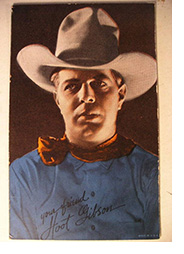 HOOT GIBSON
Edmund Richard Gibson was born on August 6, 1892 in Tekamah, Nebraska. The family moved out to Southern California when he was seven. Still a boy, he gravitated to the life of a working cowhand. Hoot would offer to put a handle on the wildest bronc around so that even a frail, spinster school marm could ride the broom tail to church on Sunday mornings. At 15, Hoot Gibson joined up with the Miller Brothers 101 Ranch in Bliss, Oklahoma and later with the Dick Stanley - Bud Atkinson Wild West Show, with his pard Art Acord. The two, wild eyed bronco twisters ventured to Southern California where they both obtained stunt work in D W Griffith's Two Brothers (1910). Hoot also secured bit parts in Tom Mix one and two reelers at Selig Polyscope and both he and Art hired out to do stunt work at Inceville, along with their former 101 ranch, bunkhouse cowhands.
 In between films, Hoot and Art would compete in the relatively new sport of rodeo. In 1912, Hoot won the All Around Cowboy title at the Pendleton Round Up while Art won the All Around Champion Steer Bulldogger event. In Pendleton, Oregon, Hoot not only won a diamond studded belt, he picked up a bride too....well sort of. Rose August Wegner, a rodeo performer, checked into a local hotel with Hoot and registered as Mr. and Mrs. Edmund Gibson. Interesting enough, supposedly they hadn't met before the Pendleton Roundup. Either Hoot was a fast talker or drunk or both. Hotel accommodations were scarce and as such priority was given to married folks. No records are known to exist that prove they were actually married, however they remained a couple. Later, Rose was asked to fill in for actress Helen Holmes, who was ill, in the longest running series of films in the history of Hollywood, 119 one reel movies, each with a completely new story - The Hazards of Helen (1914). She used the name Helen Gibson in 69 of the film shorts (10 to 12 minutes), performing some of the most dangerous stunts in movie history. Helen even obtained occasional work for her common law husband Hoot. Helen Gibson remained in demand the rest of her life, performing dangerous stunts, while doubling for leading ladies.
 In 1915, Hoot obtained stunt work and small parts at Universal studios in two reelers with Harry Carey. Jack Ford, a youthful director, and brother of popular actor Francis Ford, eventually began directing the Cheyenne Harry films, featuring Harry Carey. Straight Shooting (1917), a five reel western, remains one of the most popular of the series. Hoot had a major role in the film as well serving as the stunt double for Harry. WW I brought out the patriotism in Hoot, so he joined the US Army and was assigned to the Tank Corp. After Armistice Day, Hoot returned to Universal where he began playing the lead in two reel films. His first, full length, feature starring role was in Action (1921), which was directed by Jack (John) Ford.
In his early days in films, Hoot played many different parts and performed stunt work doubling for both the leading men as well as the heroine stars. Hoot, reflecting on this period, once shared: "I hired out to be an Indian in the morning, then turned around and chased myself all afternoon." In Diana Serra Cary's book The Hollywood Posse, aka former child star "Baby Peggy," told the story of a director at Universal, asking Hoot if he'd like to make an extra five dollars just for being dragged by a runaway horse. The Hooter, in his folksy way, replied "Make it ten and I'll let him kick me to death."
The late William K Everson, film historian, in his book A Pictorial History of the Western Film, noted that in Hoot's early days, in two reel films at Universal, his intent "was to develop a slow, bantering comedy style, with little action and simple story lines. Because of their sheer novelty and Gibson's ingratiating style - plus the fact that he was an ex-rodeo champ and could deliver the action goods when required - these shorts were extremely popular." Hoot would use the same basic formula in most of his films in the 20s and 30s.
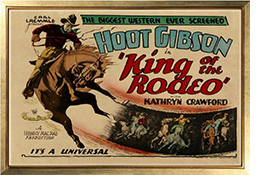
From 1922 thru 1930 Hoot Gibson would make six to eight feature westerns a year for Universal, most with high production values. The most popular of that period were: Let Er Buck (1925), The Calgary Stampede (1925), Chip Of The Flying U (1926), The Phantom Bullet (1926), The Flaming Frontier (1926), Painted Ponies (1927), The Wild West Show (1928), Trailin Trouble (1930) and Spurs (1930). The latter two were "all talking" films. Speaking of the sound movies, William K Everson remarked that Hoot Gibson's Trigger Tricks (1930) "may well set a record as the most talkative talkie western ever made." Seems as though the producer - Hoot Gibson, may have gotten carried away with dialogue you actually could hear! The finest western film director in history - John Ford, once said "When a motion picture is at its best, it is long on and action and short on dialogue." Hoot, even though previously directed by "Pappy Ford", evidently missed that lesson...he evidently was caught up in the novelty of this new thing called "talking" pictures.
During this period, Hoot became one of the highest paid actors in all of Hollywood - $14,500 per week. However, like other former cow punchers who migrated to Hollywood and struck gold, he was not use to having large sums of money and so he spent it on real estate, automobiles, planes and ex-wives.
Not only, did the kiddies like Hoot Gibson westerns, their parents did as well. His on screen persona was like his off screen personality. He was affable, a bashful Romeo, seldom carried a pistol or had it tucked away in a boot, often utilized comedy and was not your typical, handsome leading man type...guess he was more like the mainstream Americans who paid their dimes in order to see Hoot Gibson picture shows. However, Hoot could ride anything with hair on it, rope a jack rabbit on the run and would fight just for the love of it...sometimes getting knocked down on his keister.
In 1930, Hoot Gibson reached out to his former rodeo pard, drinking buddy and occasional sparring partner - Art Acord, who had fallen on hard times. Art was cast in a small role in his Universal's Trailin' Trouble. Being an "all talking" film, Art even had a line to deliver. Art Acord was a mere shell of his former self. He was once a rugged, handsome, major cowboy star for the same studio. He looked ten years, older than he really was. Art would die alone, only nine months after Trailin' Trouble was released, in a Mexican flop house hotel, cause of death - questionable.
Hoot married Helen Johnson in 1922 and they had a daughter, Laura, his only child. However, his new bride was the second Helen Gibson, as Helen Gibson 1 (Rose Wegner), Hollywood stunt woman, was still using his surname. As most celebrity marriages go, the second Helen Gibson filed for a divorce in 1930, claiming infidelity. Hollywood romances were akin to Doctors having affairs with their nurses because they were around them daily in close quarters. Likewise, leading men would sometimes fall in love with their leading ladies...in this case; the correspondent identified by Helen was actress Sally Eilers, who had made a few westerns with Hoot. The second Helen Gibson got half of all they owned as well as child custody. Hoot and Sally were married as soon as the divorce was final. However, as true to form, the marriage didn't last long, as they were divorced in 1933.
Carl Laemmle, studio chief at Universal, being concerned about the future of westerns in the sound era, did not renew Hoot's lucrative contract which included his having his own production company ala Buck Jones. Even though, he had made the studio lots of money, Carl didn't want to gamble with such a large, guaranteed, salary. However, Hoot due to his immense popularity, quickly signed a contract with Allied Pictures. The first film for Allied was Clearing The Range (1931), which was the last film Sally in which would costar with her husband.
Hoot made eleven films for Allied with the last being The Fighting Parson (1933). Hard Hombre (1931) was a reputable film, while the remainder of the Allied oaters was not of the same quality as the Universal, feature length westerns. However, the public continued to attend the double feature, motion picture show in order to watch Hoot Gibson, one of their favorite cowboys.
Hoot was one of many Hollywood cowboys who loved flying areoplanes.....an expensive hobby and sometimes a dangerous one at that. In 1933, he and Ken Maynard were entered in the National Air Races held in Los Angeles. Hoot struck a guide pole and plummeted to the ground. His plane was totally demolished. Ken Maynard, seeing the condition of his friend's plane, landed quickly in order to rush to the aid of Hoot. Most everyone thought he was dead...probably Hoot thought so as well. He did survive, however was hospitalized for several months with severe, multiple injuries. Carl Laemmle wanted to resign Hoot for Universal; however Max Hoffman, the owner of Allied Pictures wouldn't release him from his contract. By the time a deal was consummated between the two studio executives, Universal resigned Buck Jones to meet the void in not having a. cowboy star on the lot. As such, Hoot narrowly missed out on returning to the studio he had helped build and where he had spent sixteen years of his life.
In 1935, Hoot made two films for First Division, another small independent studio. Rainbows End was the better of the two. He was then cast to costar in a film with Harry Carey, based on a novel by William Colt MacDonald featuring The Three Mesquiteers - Powdersmoke Range (1935). The RKO film was the Grand Hotel of B westerns in that it contained an all-star cast of sagebrush veterans: Harry Carey as Tucson Smith, Hoot Gibson as Stoney Brooke and Guinn "Big Boy" Williams as Lullaby Joslin. In addition, Bob Steele, Tom Tyler, Buzz Barton, Hal Taliaferro (Wally Wales), Art Mix, Jay Wilsey (Buffalo Bill Jr.), Buddy Roosevelt, Franklyn Farnum, William Desmond and William Farnum. All of these actors in the supporting cast were at one time, leading men in silent western photoplays. The Three Mesquitters became an ongoing popular series with a variety of western stars including John Wayne.
Hoot then signed with Diversion to make Swifty (1935), the best of six films he did for the indie company. In between, he was cast in the popular RKO film The Last Outlaw with Harry Carey. His final film for Diversion was Frontier Justice (1936). Hoot was assigned to the number two role in Republic's The Painted Stallion (1937), a 12 chapter serial. It starred Ray "Crash" Corrigan, who would go on to have a successful career in the Three Mesquiteers series. However, upon its release, casting calls ended for Hoot. To support his lavish life style, he had to start making public appearances at state and county fairs and rodeos out on the sawdust trail. Hoot was featured first with the Haganback - Wallace Circus, Robbins Brothers Circus and the Russell Brothers Circus. At one time, he supposedly even had a trading post in Hollywood. Also, Hoot Gibson remarried in 1942 to one Dorothy Dunston, a former radio singer.
Based upon the success of the Three Mesquiteers films with Bob Livingston, Crash Corrigan and Max "Alibi Terhune and the Rough Riders series with the late Buck Jones, Tim McCoy and Raymond Hatton, Producer Robert Tansey packaged a new series for Monogram - The Trail Blazers. Ken Maynard and Hoot Gibson were summoned out of their forced retirements. The sad part was the two former super stars were getting long in the tooth and there was a noticeable paunch over Ken's gun belt. The first film was Blazing Guns (1943). Bob Steele was added one time for Death Valley Rangers (1943). Bob eventually replaced Ken Maynard who left after the fifth production - Arizona Whirlwind (1944), as he didn't want to share the billing any longer. Hoot Bob Steele, and Chief Thunder Cloud would costar in five more films for Tansey, ending with Trigger Law (1944). These films were made rather cheaply, however they were not without some merit as some of the action scenes were well done, of course by stunt men for the aging actors. Hoot and Ken each received $800 per film. In comparison to their former salaries, it was pocket money. However, they needed the work and eight C notes was a pretty good payday in the early 40s. Trigger Law was the last starring film for Hoot. Many of the youth in this period were more into the singing cowboys like Gene, Roy and Tex.
Hoot spent the rest of his life involved in various business ventures, some which were misguided. He operated a rodeo for a while in Saugus, CA (now Santa Clarita) and took it on tour. Also, Hoot had a television show with a sponsor hawking Arista Blue Chinchillas! He also had a role in a low budget, nostalgic movie for United Artists - The Marshall's Daughter (1953), along with Ken Murray, Preston Foster, Jimmy Wakely and Johnny Mack Brown. Later, Hoot had cameo roles in The Horse Soldiers (1960), directed by his old friend John Ford; and Oceans 11 (1960), directed by the also famous, award winning director Lewis Milestone. By that time, Hoot had spent every dollar that he had earned and then some. He and Dorothy had moved earlier to Las Vegas where he served for a time as a greeter at the Last Frontier Casino. It was his last frontier as well. Hoot died in the Motion Picture Home in Woodland Hills, CA on August 23, 1960, succumbing to cancer which he had fought for years.
Hoot Gibson was one of the most popular cowboy silver screen heroes of the 20s and 30s. From the early 20s to the mid-30s, Tom Mix, Buck Jones, Ken Maynard, Tim McCoy and Hoot Gibson were the most admired western stars. Director Harry Frazer in his memoirs noted: "Hoot Gibson led a stormy life, yet all told, it was a wonderful life. He was one of the most generous cowpokes ever to ride the silver screen. He was forever giving gifts - some of them very costly - to his countless friends and pals. Hoot was riding with me to location one day when my Lincoln threw a couple of connecting rods and made a wreck out of a beautiful car. As we stood looking at the mess, Hoot said 'Don't worry Harry, we'll see to it you get another Lincoln' and he did - with the compliments of one of the finest gentlemen I've ever had the pleasure of directing." That was a right proper eulogy for a deserving old cowhand from Tekamah, Nebraska, who made it to the big show in Hollywood.
For further information on Hoot Gibson and other western film stars, I recommend: The Old Corral at www.b-westerns.com Chuck Anderson, Webmaster; subscribe to Boyd Magers' newspaper Western Clippings, for information go to his website www.westernclippings.com; Buck Rainey's The Strong Silent Type - Over 100 Screen Cowboys, 1903 - 1930 McFarland & Company; and A Pictorial History of the Western Film The Citadel Press; and The Hollywood Posse by Diana Serra Cary, University of Oklahoma Press.
________________________________________________________________________
GARY E BROWN
is the retired Police Chief of Monterey, CA; Ashland, OR and San Clemente. However, his avocation is collecting western art and memorabilia including many Tom Mix items. Tom Mix was his father's hero, so he is Gary's as well. Gary wrote an article on Tom Mix for The National Film & Collectors Magazine - Hollywood Studio Magazine, as well as a recent article on Tom Mix's final day for American Cowboy magazine. He has also written articles on the Western Photoplays of the Golden Era and lectured on the Western Heroes of the Silver Screen. He can be reached at montereycowboy@hotmail.com or found, most mornings, at his son Jordan's Mavericks Coffee House in Visalia, CA....the site of "possibly the best coffee in the world" with walls of vintage cowboy movie posters and a collection of 66 original, autographed photos of yesterday's cowboy heroes.


We want to hear from you!
Have a story idea or an event you want us to include? Want to see us feature a particular artist or artisan? Have a recipe to share or an idea for a new series? Send us your ideas or submit a written story – we’d love to feature it. After all, Smoke Signals is a magazine for YOU and about YOU!
Editorial Submissions Questions/Feedback
Linda Kohn Sherwood, Editor
smokesignals@highnoon.com
Smoke Signals is not responsible for unsolicited materials.
ABOUT SMOKE SIGNALS
Founded: February 2009
Owned & Produced by: High Noon LA, Inc.


If problems with website occur, please contact the webmaster. Site designed by Ireland Graphic Design.