

Roaming Range Reporter
Continued from November 2012, Smoke Signals

Reel Cowboys of Western Cinema
A Century of Silver Screen Heroes on Horseback
No. 8 in the series
By Gary Eugene Brown
There were numerous cowboy actors during the 20th Century who were idolized by their adoring fans, who in their opinion could do no wrong. However, a few in real life, maintained a different persona than that projected on the screen. However, this months' featured cowboy hero was without malice, a person of integrity and beloved by those in the entertainment industry, as well as the general public. He lived his life without scandal and was most concerned about the plight of children. He also was a patriot, having served his country in battle, and then stepped up again to do his duty by promoting US War Bonds when he was a household name. However, he had to change his name when he became a leading man, as his Aryan surname may offend some persons due to the Great War having recently ended. Charles Frederick Gebhart went on to become the most popular cinema star in Hollywood in the mid-30s. His fan mail exceeded that of Clark Gable, Spencer Tracy and Humphrey Bogart. Local theater marquis' throughout the nation read: Now Playing:
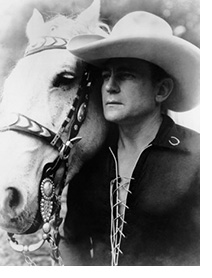 BUCK JONES
Birth records were lacking in Vincennes, Indiana on December 12, 1891, however most agree that was the date Charles Gebhart was born. Charles spent his formative years in Indiana. As a boy, he would hang around the local stables which led to his love and appreciation of horses. His parents separated when he was only 10. He dropped out of school after the 8th grade and was soon on his own. At age 15, Charles cajoled his mother to not reveal his true age so he could enlist in the Army. Charles entered the US Army on January 8, 1907. He joined Troop G, 6th US Calvary and was sent to Nogales, Arizona for basic training.
Patrolling the border was not an easy assignment and more than once a bullet was fired in his direction from a smuggler or cattle rustler. Later, his unit was shipped off to the Philippines (October 1907). The Mindanao region was overrun by Moro's (Muslim extremists) who resented US control. While on patrol, a bullet shattered the bone in his left leg. The Army discharged him as he was not physically fit. Healthy again, he re-enlisted in the Calvary in 1910 and was sent back to his former unit, where he attained the rank of Sergeant. He mustered out of the Army in 1913 in Texas City, Texas. Not sure what he was going to do next, Charles saw an ad that the Miller Brothers 101 Ranch Wild West Show was going to Galveston.
Charles, still a boy when he approached Joe Miller about a job with the 101. He was not a cowboy in the true sense; however he had plenty of horse knowledge, thanks to the US Calvary. Miller liked his attitude and gave him work currying their many horses. When a position opened up for a performer, Charles demonstrated his skills in horsemanship. He excelled as a rider and soon became the top bronc peeler for the 101. About this time, he was called "Buck" by his pals. He went on to become a featured trick rider. When the 101 Wild West Show shut down for the winter, Buck performed the daily chores of a cowboy.
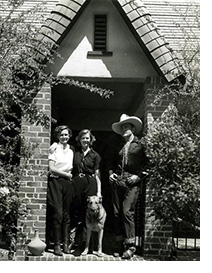 During a performance at NYC's Madison Square Garden in 1914, Buck met a pretty teenage trick rider by the name of Odille "Dell" Osborne, who had just signed on with the 101. Buck Gebhart was sure enough smitten with the young lass. Dell signed with the Julia Allen Show for the next season and the 101 show was bound for Europe. Buck not wanting the love of his life to get away later joined the Allen troupe. However, while still with the 101, a young trick rider, also from Indiana, by the name of Ken Maynard, had been teaching the young and impressionable Dell Osborne some of his own equine stunts. Buck found an autographed photo of Ken with an amorous note inscribed to Dell. He was madder than Hades. From that time on, the two eventual super cowboy heroes were at odds with one another. Dell by this time realized she loved Buck and the two were married in center ring of the Allen show by a sky pilot on horseback, on August 11, 1915 in Lima, OH.
WW I was approaching which impacted the many Wild West shows of the day. Buck learned horses were in demand for the war effort, so he accepted a job breaking horses for the French allies at the Chicago stockyards. In 1916, the Gebhart's began performing on their own in small towns throughout the Midwest. They would tell town folks that Buck would ride "the meanest horse" in town and he did. Dell also performed her trick riding routine. They would pass the hat for tips. In 1917, they the Ringling Brothers circus and remained for one season. They resigned from the circus as Dell said they would soon be a threesome. They had saved some money and were able to rent a small house in Hollywood.
Walking down Sunset Boulevard, Buck met Curley Kelso who had helped Buck break horses for the French Cavalry. Curley encouraged Buck to try a new and growing profession - the "movies." An Assistant Director saw Buck waiting outside the Universal gate and hired him to work as an extra for $5 a day. This led to work at the William S Hart studios in Edendale. Buck learned the ropes of film making from observing Bill Hart operate and also doubled the former Shakespearean actor from time to time. This lead to stunt work with the Fox Studios beginning in 1918. Dell also became a stunt woman. She once performed a stunt of being shot off a horse and dragged on a Hart western when she was 7-½ months pregnant. Buck was furious upon learning about it, however he brought home $5 that day and she had earned $25!
One day on a Tom Mix film, a scene called for Tom and Tony to rush in front of a runaway team, driven by Dell, and reach down and grab a baby off the ground just in the nick of time. Tom performed the stunt, however in doing so; the baby's arm was broken. Tom was visibly shaken. In turn, the director asked Buck to fill in and do the scene for Tom. Buck and Dell agreed to use their own baby girl Maxine (born February 9, 1918). Dell was not worried as she knew Buck could do the scene without causing harm to their daughter and he did it perfectly!
In 1919, William Fox concerned that his famous star Tom Mix may leave someday if he didn't get what he wanted, signed Buck to a contract of $100 per week. It was a paltry sum compared to what Mix was getting, however it enabled Buck to become a leading man. At this time, Fox Studios changed his name to Charles "Buck" Jones, a more American sounding handle. Buck later legally changed his surname to Jones.
The Last Straw was the first Fox film for Buck. The studio was so pleased that they raised his salary to $150 per week. A trade publication in review of the film stated: "Jones has personality just a little different than most of the Western heroes. There is a certain sincerity of purpose about his portrayal that is sure to please."
In 1922, a cowboy rode on to the Jones' set on a beautiful gray horse. It was love at first sight so Buck bought him that day for $100. He named him Silver and from then on the two were inseparable. From 1920 to 1928, Buck Jones made 62 photoplays for Fox, including a few non westerns. Some of the Fox films were: Durand of the Badlands, Desert Valley and The War Horse.
In 1928, Buck asked permission to take his family on a much needed vacation to Europe. Sol Wurtzel, Fox executive, agreed to Buck's request and assured him his weekly salary of $3000 would continue while he was on leave. Upon returning, Buck discovered Fox Studios reneged on the paid vacation. Buck felt a person's word was tantamount to a contract. In protest, Buck quit on the spot. A bold and noble gesture, yes. However, at the time, studios were making large investments in converting to "talkies" and were concerned that the outdoor, action western couldn't make the transition to sound. Buck gave up a great career with Fox at the prime of his life.
Wondering what to do next, Buck met a former carnie by the name of A.W. Copeland, who suggested that Buck form his own Wild West Show. The idea appealed to Buck, having fond memories of the 101. As such, he provided the capital to purchase equipment from a defunct carnival and bought six new railroad cars. The Buck Jones Wild West Show and Round Up Days opened on May 12, 1929. The 267 member troupe including youngsters Monte Montana and Iron Eyes Cody left North Hollywood for tour stops throughout California and points East. However, unknown to Buck, their advance manager was embezzling funds and not paying the bills. As such, the show closed in Danville, IL. Buck had lost $250,000 of his own money. To avoid filing bankruptcy, Buck convinced creditors he would make good on all his debts. The Jones' returned to Hollywood broken hearted and indebted up to their necks.
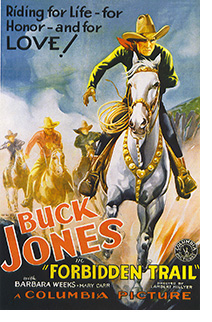 Buck hired a former director from his Fox studio days - Scott R. Dunlap, as his business manager. In turn, Dunlap introduced Buck to Sol Lesser of Beverly Pictures who wanted to make "talking westerns." Lesser convinced movie mogul Harry Cohn of Columbia to distribute a western series of 8 films, featuring Buck Jones. Buck was still a bankable star; however reality was he had to take a significant salary cut ($3000 per week to $300) in order that each film could be produced at a cost of $20,000. The Lone Ranger was released in July, 1930. The film proved that sound westerns could be filmed and that Buck had a great voice for "all talking pictures". The first film was well received. It was followed by Shadow Ranch, Men Without Law and The Dawn Trail.
In 1931, with the film Branded, Columbia took over the production of all Buck Jones movies. Buck would go on to make eighteen more westerns for Columbia as well as two melodramas. Variety's review of Border Law (1931) noted: "One of the best westerns at Loew's New York since sound arrived. Action in every inch of the film, and a kind that also grips the average adult attention. A western that every producer of westerns should see and profit by, for the sake of America's daily change houses."
Buck was allowed to make serials for Universal, even though still under contract to Columbia. Gordon of Ghost City (1933) was the first of the six cliff hangers that Buck would make for Universal and a good one it was. The success of the first two serials led Buck to eventually sign a contract with Universal Studios to make western pictures. The first was Rocky Rhodes (1934) which also had Buck in the role of Producer.
Sudden Bill Dorn was the last film Buck made for Universal, a total of twenty. Carl Lammle, Studio CEO wanted to keep Buck; however there was disagreement over salary. As such, Buck signed with Coronet Pictures. Columbia, his former studio, had an arrangement to handle the film distribution. Even though the quality overall was not as good as the Universal westerns, some of the films were well received, including the last California Frontier (1938).
Buck was eventually able to pay off his debtors from the Wild West fiasco. Also, he was able to financially invest in American youth, his primary, philanthropic interest. With the help of Universal, earlier on, he founded the Buck Jones Rangers, an organization that stressed good citizenship and sound character. At one time, there was a membership of several million. An example as to his fondness for children, Buck heard about a fan of his in New York City, by the name of Joe Collins, who had suffered major injuries from a near fatal fall. When asked why he was not crying having sustained major injuries, young Joe's reply was "I'm no sissy. Buck Jones wouldn't cry." Buck was so moved that he flew to the Bronx to visit young Joe, bearing gifts.
The Jones family eventually united with the Berry family (Wallace and Noah) of Hollywood fame. Daughter Maxine married Noah Berry Jr., on March 30, 1940. They had three children: Muffett, Bucklind and Melissa. However a divorce eventually took place in 1965. Later, Maxine married a notable western artist Nicholas S. Firfires from Santa Barbara.
In 1936, the Motion Picture Herald Poll of top Western Stars had Buck Jones ranked number 1; George O'Brien number 2 and a young, upstart - Gene Autry as 3. The following year, the Singing Cowboys took over the popularity poll with Gene Autry as #1. Buck slipped to 4th. By 1940, Gene was still in first place, while Buck was no longer in the top 10. Buck Jones' spotlight was fading and saddle balladeers were the toast of the town. Buck was proud of being a real top hand and not just a prairie crooner. In an interview, he shared his views on the new phenomena of the singing cowboy: "They use 'em to save money on horses and riders and ammunition. Why, you take Gene Autry and lean him up against a tree with his guitar and let him sing three songs and you can fill up a whole reel without spending any money. That's why they've overdone the singing, and that's why they're on the way out. In my pictures, we never let up on the action." Buck misjudged the popularity of the singing cowboy.
1939 and 1940 were not banner years for Buck. He obtained a co-starring role of a crooked sheriff to good guy Chester Morris in Republic's Wagons Westward (1940), a complete role reversal. Columbia then remade one of Buck's earlier pictures - White Eagle (1941) into a 15 chapter serial using some stock footage from the 1932 film. Then Buck played second fiddle to the cowboy crooner Dick Foran in Universal's serial Riders of Death Valley. However, these films helped renew his popularity.
Based upon the success of a trio on horseback - Republic's The Three Mesquitters, his agent Scott Dunlap approached Buck about forming a production company to make westerns with a team of "three old-timers in a slam-bang action series." In turn, they formed Great Western Pictures and entered into an agreement with Monogram Studios to distribute the films.
They chose the still popular Tim McCoy, who held his age well, and for comic relief selected the veteran Raymond Hatton to round out the trio. Film historian William Everson commented in his fine book - A Pictorial of the Western Film (1969): "Jones, McCoy and Hatton made one of the best co-starring trios of any Western series." Jon Tuska in Views and Reviews (1971) reported: They were the finest Westerns Monogram was associated with up to that time and probably the best they ever would release." "The initial success of this series can be attributed to the fact that that it featured leading men who could act and who seriously devoted themselves to the art of the cinema Westerns." The first production was Arizona Bound (1941). Variety noted: Monogram introduces a new western series, headed by Buck Jones. Seen too infrequently over the past few years; plus Tim McCoy and Raymond Hatton. The trio is a stout one and Arizona Bound is an auspicious debut indicting the group is headed for full approval from fans of outdoors action sagas." Nine films were in the series, the last being Dawn of the Great Divide (1942) with Rex Bell in place of Tim McCoy who moved on after eight films.
Before the release of Dawn of the Great Divide, Buck once again was asked to serve his country by going on a two week US War Bond drive to the East Coast. We were in the midst of WW II, fighting on two fronts. In Boston, on Saturday morning, November 28th, Buck went to visit the children's hospital and then to a youth rally at the Boston Gardens where he received the greatest ovation he'd ever had, by approximately 12,000 young, faithful fans. That evening, he joined Scott Dunlap and a small party of Monogram film representatives who wanted to give Buck a testimonial party at the famous Coconut Grove night club.
At approximately 10 PM, a bus boy was asked to replace a burnt out bulb in a corner of the room that was decorated with paper Polynesian symbols. He struck a match to locate the light socket and in doing so, set off an instant fire storm. Over 1000 people were in the night club which had an occupancy limit of 750. Panic set in as all tried to escape through the few exits at the same time. The lights went out and in a matter of minutes, over 200 died in one location, stacked upon one another like firewood, trying to exit thru the main entrance. 492 died as result of the fire, including the popular cowboy hero Buck Jones.
There have been different stories regarding the death of the famous actor. One is that he was able to exit, however came back to help rescue others in a heroic gesture and was overcome by smoke. However, other reports were that he remained inside trying to find his friend Scott Dunlap, who exited the club safely. Buck died on November 30, 1940, due to injuries sustained. Regardless as to what really happened, we should remember that Buck volunteered to go on tour for his country, to help sell US War Bonds, in a time of need. As such, he did die as a hero. The body was returned to California where it was cremated and buried at sea.
Jimmie Fidler, famous Hollywood columnist of the early era, wrote a tribute to the fallen cowboy star: "Acting is the most competitive profession in the world, and actors, being of necessity self-centered, are far more inclined than other people to nurse bitter jealousies." "In more than 20 years of Hollywood reporting I have not known more than half-a-dozen stars able to avoid being the target for someone's jealous resentment and hate. Perhaps the most notable of that half-dozen was Charles "Buck" Jones, the veteran cowboy who lost his life in the Boston nightclub holocaust. The laudatory remarks showered by Hollywood on any one of its celebrities, after that celebrity had died, are usually insincere. Hollywood is theatrical, always eager to be impressed by its own eloquence in chanting the praises of its dead. Nine times out of ten, its funeral orations are as phony as the script writer's tear-jerkin scenes. But the eulogies to Buck Jones nearly were delivered before his death - by the little people of the industry as well as by the big shots. He was a star for nearly two decades, subject to all the poisonous envies that flourish here - - yet I never heard anyone speak of him without adding, 'A swell guy' or 'A regular.' No high-flown oratory there - - but those commendation come from the heart. They were a glorious epitaph - - and like all epitaphs worth preserving, they were offered while their object still lived."
Western film historian, the late Buck Rainey, wrote two wonderful volumes on his boyhood hero: The Life and Times of BUCK JONES The Silent Era and The Life and Times of BUCK JONES The Sound Era (The World of Yesterday, Waynesville, North Carolina, 1988 & 1991). In the Prologue of the 2nd volume, Rainey wrote: "For over 20 years Buck Jones was in the limelight - never once during that time did he lose the worship and affection of millions of youngsters to whom the billing 'Buck Jones and Silver' was as important as the gilded display of a million dollar epic. Buck was representative of an era fondly remembered by those who were kids in the Depression years. His westerns were fun to watch. What more could an overall-clad, towheaded, freckled-face kid desire in those golden years than a walk on a pleasant summer afternoon or evening to the 'picture show' to watch Buck and Silver in action, unless it was to offer popcorn and a sip of coke to the little girl who was the 'most beautiful thing ever' - - next to Buck and Silver, that is. Buck and Silver represented good, clean, fantasy entertainment in those harsh, yet beautiful, depression years. Escapism was the order of the day and the perils of the Old West admirably met the need for escapism."
________________________________________________________________________
GARY E BROWN
is the retired Police Chief of Monterey, CA; Ashland, OR and San Clemente. However, his avocation is collecting western art and memorabilia including many Tom Mix items. Tom Mix was his father's hero, so he is Gary's as well. Gary wrote an article on Tom Mix for The National Film & Collectors Magazine - Hollywood Studio Magazine, as well as a recent article on Tom Mix's final day for American Cowboy magazine. He has also written articles on the Western Photoplays of the Golden Era and lectured on the Western Heroes of the Silver Screen. He can be reached at montereycowboy@hotmail.com or found, most mornings, at his son Jordan's Mavericks Coffee House in Visalia, CA....the site of "possibly the best coffee in the world" with walls of vintage cowboy movie posters and a collection of 66 original, autographed photos of yesterday's cowboy heroes.


We want to hear from you!
Have a story idea or an event you want us to include? Want to see us feature a particular artist or artisan? Have a recipe to share or an idea for a new series? Send us your ideas or submit a written story – we’d love to feature it. After all, Smoke Signals is a magazine for YOU and about YOU!
Editorial Submissions Questions/Feedback
Linda Kohn Sherwood, Editor
smokesignals@highnoon.com
Smoke Signals is not responsible for unsolicited materials.
ABOUT SMOKE SIGNALS
Founded: February 2009
Owned & Produced by: High Noon LA, Inc.


If problems with website occur, please contact the webmaster. Site designed by Ireland Graphic Design.