

Roaming Range Reporter
Continued from August 2012, Smoke Signals
 Reel Cowboys of Western Cinema
A Century of Silver Screen Heroes on Horseback
By Gary Eugene Brown
Over hundred matinee idols have ridden across the silver screen. Many had been hired men on horseback in a prior life. However, there were a few thespians, city born and bred, who rode as though they were one with the horse. One of the best is featured in this months' continuing series.
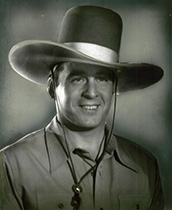 GEORGE O’BRIEN
At the start of the 20th Century (April 19, 1900), George O'Brien was born into a traditional Irish Catholic family in San Francisco. His father Daniel O'Brien was a Police Officer. Young George experienced the historic disaster - San Francisco Earthquake (1906) in which 3000 people lost their lives. George excelled in four prep sports. He also learned to rope and ride at a ranch near Los Gatos and would later train horses for the SFPD. His father, who would become Police Chief in 1920, and his wife Margaret wanted their son to become a doctor, however WW I altered their plans forever. George joined the Navy and became a "stretcher bearer" for the USMC. He was in the midst of the heaviest fighting in Bellaeu Wood and received several decorations from both the French and US, including the Silver Star. While in the Navy, George became the Light Heavy Weight Boxing of the Pacific Fleet.
 After the war, George met the legendary Tom Mix who invited him to join his film crew as an Assistant Cameraman. This was George's entre' into the magical world of filmmaking. At Mixville, George worked for Dan Clark who would become one of Hollywood's finest cinematographers. George and Dan rented an apartment and eventually shared it with eventual Academy Award winning director Lewis Milestone. After working for Mix for two years, George became restless and joined cowboy actor Art Acord's film crew bound for Old Mexico. The company folded so George signed on as a deckhand on a sailing ship bound for the South Seas. After his return, George while waiting at the dock to board another schooner, saw a fight break out. George attempting to stop it discovered he'd interrupted the filming of a fight scene. The famous actor Hobart Bosworth was filming White Hands. George, who'd met Bosworth previously, was challenged by the actor to join his film crew and show the actors how to really fight. In turn, George started getting bit parts and stunt work. In 1922, he was in Valentino's Moran of the Letty Lady. George volunteered to take a 60 foot dive from the foretop spar of a schooner. He finally was in front of the camera.
Popular actor Richard Dix encouraged George by betting bet him he would become a popular film star within one year. Dix would later collect his bet. William Fox had selected John Ford to direct an epic western on a grander scale than James Cruzes' heralded - The Covered Wagon. The Iron Horse (1924) was about the construction of the transcontinental railroad. George was invited to test for the lead role of Davy Brandon. According to David W. Menefee's, excellent biography George O'Brien, A Man's Man in Hollywood, the curmudgeon director told O'Brien "You haven't a chance you know that George" as they walked to a film test. "Yes, I know" replied George. Unknown to Ford, George was about to give up on becoming a film star. Ford went on "You mustn't set your heart on it...You know we've tried out over 50 fellows, all experienced actors." Ford selected George over the objections of studio executives who didn't want an unknown to play the leading part. His response was - "Well, we'll kill him or cure him in the first scene...If he gets through the first day, he'll do."
Filmed on location in Mexico, New Mexico and then in Northern Nevada during the winter, it was almost unbearable working conditions for both cast and crew. However, the harsh elements provided an almost documentary feel to the film. The movie opened to rave reviews and played for a year in New York as a "road show" engagement. It made George O'Brien a star and led to a 10 year contract with Fox. John Ford would use George as his leading man in six films. It was the beginning of a close friendship between the two.
The next western the duo was involved in was also a major film...3 Bad Men. Filmed primarily in the Jackson Hole area, the story of 3 outlaws helping a young damsel in distress is a beautiful panoramic film, one of the best in the history of western cinema. George O'Brien played the good guy who falls for leading lady Olive Borden, both on and off screen. Frank Campeau, Tom Santschi and J. Farrell McDonald played the three, somewhat loveable desperados.
George O'Brien made several classic films without boots and spurs. They included critically acclaimed films: The Johnstown Flood, Fig Leaves, The Blue Eagle and Noah's Ark. However, one of the finest films made in the twenties (1927) was the German director FW Murnau's Sunrise: A Song of Two Humans. The story of a husband (George) and wife (Janet Gaynor) in a small village, whose lives are intertwined with a woman from the city, is often listed as one of the top three films made in this period. George O'Brien was more than a cowboy!
Fox Studios assigned George to star primarily in westerns beginning with Zane Grey's The Lone Star Ranger (1930). The Fox westerns were clearly above most B oaters. Fox provided an ample budget for these westerns. The 18 "all talking" westerns included enjoyable films including: Last of the Duanes, Riders of the Purple Sage and Robbers Roost.
In 1932, John Ford invited George to accompany him on a three month freighter trip to the Philippines. The foreign press was excited to cover the first major movie star to visit Manila. Ford went on a 10 day binge and never left his room. George covered for his friend saying he had a severe fever. George decided to go on alone as he could not sober up Ford. The director eventually joined George on a trip to Japan, China and Indonesia, stopping in Hawaii on their return. Again, the press focused on George and ignored Ford. Little did George realize that Ford resented George for leaving him in Manila. As such, he wouldn't cast him again in one of his films. This hurt George deeply.
When casting for Zane Grey's classic Riders of the Purple Sage was discussed, George lobbied for Marguerite Churchill. She played in Raoul Walsh's big budget western The Big Trail (1930) costarring a young John Wayne. George was smitten having seen her on the Broadway stage. Later, when Fox agreed to his request, George accompanied director Hamilton McFadden to interview her. "Well, when do we start? Marguerite asked. George replied "...we go on location to Arizona (in August)..." "What, Arizona in mid-August?" George chided her "That shouldn't bother an actress from the stage in New York." "But, Mr. O'Brien, I didn't play on the stage in mid-August!" The film led to romance, marriage and children.
George made films for RKO as well as Fox, beginning with Thunder Mountain in 1935. He made 20 westerns for RKO over a five year period, including several quality B movies including, among others: The Painted Desert, Arizona Legion and Daniel Boone. RKO wanted to reduce production costs of O'Brien westerns and signed Tim Holt at a much lower salary. On the horizon was WW II which would change the world including the life of George O'Brien.
George, age 42, reenlisted in the US Navy. He could have gotten a deferment as he was married, the father of two and a public figure; however he didn't want to shirk his duty. He participated in 15 invasions in the Pacific including Saipan and Leyte. He was shot in the leg and came down with double pneumonia. George stayed in the Navy for 6 years leaving at the rank of Commander. His many fans wrote RKO inquiring about his absence. He was at the height of his career when he joined up. His sense of duty and a strained relationship with Marguerite kept him away from Hollywood. The lengthy absence ended his career as a leading man.
George wasn't able to find film work due to being away so long. However, Warner Brothers for My Wild Irish Rose (1947) starring Dennis Morgan and Arlene Dahl, was looking for a "George O'Brien type" for the role of the Iron Duke, America's strongest man. Some thought George was dead. Jack Warner saw the film test of George and said "That's the guy!" Unknown to George, Marguerite called John Ford and encouraged him to find a part in his upcoming western Fort Apache starring John Wayne and Henry Fonda. Ford was reluctant until Marguerite told him that he would "help keep a good Catholic marriage together." George joined the cast and both he and Jack Ford renewed their friendship. The legendary director would use George in She Wore a Yellow Ribbon and Cheyenne Robin. It was George's last film and Ford's final western.
George's personality changed after the war as he became sullen and aloof, according to Marguerite. However George re-upped for the Korean War, eventually retiring as a US Navy Captain. This resulted in Marguerite filing for divorce. George remarked "My biggest sorrow and disappointment came when my wife Margie filed for divorce. I'd married Margie prior to WWII and she had stuck with me during those long, lonely years of absence, so when the Korea mess happened and I again returned to duty, she couldn't take it." George would never remarry. He suffered a major stroke after moving to Broken Arrow, OK to be close to his son. He remained in bed the last few years of his life and died on September 4, 1985, at age 86
Prior to his stroke, George O'Brien would occasionally attend a movie festival. Ed Hulce, Director, Cinecon Festival 79, screened Sunrise, Noah's Ark, 3 Bad Men and four other O'Brien films. Mr. Hulce sat alongside George when they showed Sunrise. At the end of the film, an emotional Ed Hulce wiped his eyes and George leaned over and said "Thank you for the tears." Initially, George wasn't too interested in attending the event, wondering why the interest after all these years. He shared that "I'd just as soon be remembered as an old Navy man than a movie star." He was buried at sea by the US Navy. That was the real George O'Brien, Captain, US Navy.
________________________________________________________________________
GARY E BROWN
is the retired Police Chief of Monterey, CA; Ashland, OR and San Clemente. However, his avocation is collecting western art and memorabilia including many Tom Mix items. Tom Mix was his father's hero, so he is Gary's as well. Gary wrote an article on Tom Mix for The National Film & Collectors Magazine - Hollywood Studio Magazine, as well as a recent article on Tom Mix's final day for American Cowboy magazine. He has also written articles on the Western Photoplays of the Golden Era and lectured on the Western Heroes of the Silver Screen. He can be reached at montereycowboy@hotmail.com or found, most mornings, at his son Jordan's Mavericks Coffee House in Visalia, CA....the site of "possibly the best coffee in the world" with walls of vintage cowboy movie posters and a collection of 66 original, autographed photos of yesterday's cowboy heroes.


We want to hear from you!
Have a story idea or an event you want us to include? Want to see us feature a particular artist or artisan? Have a recipe to share or an idea for a new series? Send us your ideas or submit a written story – we’d love to feature it. After all, Smoke Signals is a magazine for YOU and about YOU!
Editorial Submissions Questions/Feedback
Linda Kohn Sherwood, Editor
smokesignals@highnoon.com
Smoke Signals is not responsible for unsolicited materials.
ABOUT SMOKE SIGNALS
Founded: February 2009
Owned & Produced by: High Noon LA, Inc.


If problems with website occur, please contact the webmaster. Site designed by Ireland Graphic Design.